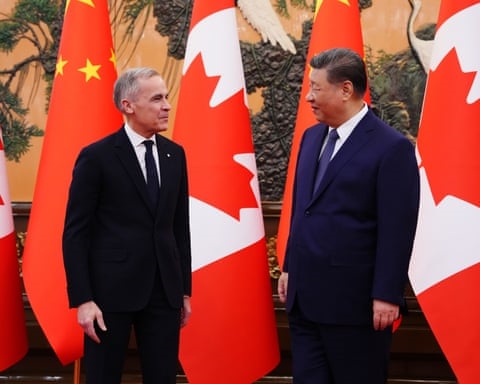
Prime Minister Mark Carney has firmly stated that Canada is not seeking a comprehensive free trade agreement with China. This declaration comes in response to heightened rhetoric from south of the border regarding potential punitive tariffs.
Carney emphasized that recent adjustments with Beijing were limited in scope, designed only to address specific tariff imbalances on a handful of sectors. He clarified that these moves do not signal a shift toward a broader free trade pact, a path he said Canada has no intention of pursuing with non-market economies.
The context for these clarifications is a recent, targeted agreement. Canada agreed to lower its 100% tariff on Chinese electric vehicles, which was implemented in 2024, in exchange for reduced Chinese tariffs on certain Canadian agricultural exports like canola oil and pork. Under the new terms, Chinese EV imports will face a 6.1% tariff with an annual quota, a framework Carney described as a corrective measure for recent trade frictions.
These developments have drawn sharp criticism from U.S. figures, who have warned against allowing Canada to become a conduit for Chinese goods into the American market. The U.S. Treasury Secretary questioned the move, suggesting it aligned with a broader internationalist agenda rather than practical trade policy.
The trade discussion occurs against a backdrop of wider geopolitical tensions. Carney has recently positioned himself as a vocal advocate for middle-power nations to collaborate in an increasingly polarized global landscape, a stance that has contrasted with the current U.S. administration’s approach. This divergence was highlighted at a recent international forum, where Carney’s calls for collective action among midsized countries garnered significant attention.
The Prime Minister’s office maintains that its actions are consistent with its commitments under existing North American trade agreements and are solely focused on resolving discrete trade issues, not on forging a new strategic partnership with Beijing.