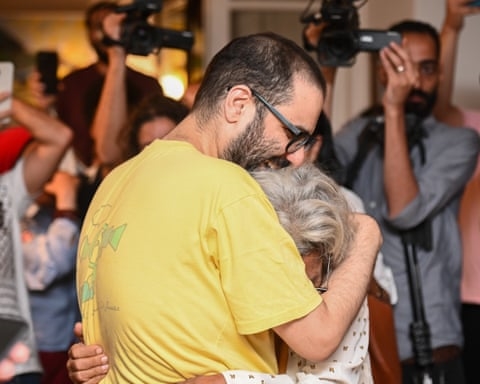
The debate over the appropriate consequences for offensive social media content has reached a new and severe pitch. For a recently freed political prisoner, the price demanded by some is not merely a ban or a fine, but the revocation of his very citizenship.
The individual at the centre of this storm is Alaa Abd el-Fattah, a writer and activist who holds British citizenship through his mother. After enduring over a decade of imprisonment in Egypt—a period marked by torture and a near-fatal hunger strike—he was finally released and recently arrived in the UK. His homecoming, a chance to reunite with his son after missing his entire childhood, was swiftly overshadowed.
Within a day of his arrival, a campaign erupted calling for his deportation and the stripping of his British status. The catalyst was a series of inflammatory social media posts he authored in the early 2010s, for which he has since issued an unequivocal apology. These old tweets, circulated by far-right figures and amplified by certain media outlets, are being presented as grounds for the ultimate penalty.
This push represents a profound escalation. It seeks to compound the punishment of a man who has already suffered immensely for his role as a leading voice in Egypt’s 2011 pro-democracy revolution. Following the revolution’s collapse under a military regime, Abd el-Fattah became a global symbol of resistance, with his imprisonment decried by human rights advocates worldwide. His release was celebrated as a rare victory.
The current campaign, however, frames him not as a dissident but as an extremist threat. Critics point to selective, decade-old posts to paint a caricature that ignores the full context of his activism and writing. Omitted from this narrative are his contemporaneous statements condemning violence against civilians, opposing sectarianism, and distinguishing between political Zionism and Jewish people. Also overlooked are his tangible acts of solidarity, such as risking his own safety to protect evidence and comfort families after a deadly attack on Christian protesters in Cairo—an act for which he was jailed.
The underlying argument from his accusers suggests that citizenship should be contingent on an individual’s past social media activity and beliefs, a precedent with alarming implications. For Abd el-Fattah, deportation to Egypt could constitute a death sentence, returning him to the authorities who imprisoned and tortured him.
The government has indicated it will review the case, a potentially vast undertaking given the sheer volume of the activist’s historical online commentary. Yet a simpler path exists: to judge him not by his worst or best tweets, but by the steadfast courage he has shown in the face of tyranny, and by the fundamental principle that citizenship is a right, not a privilege to be revoked for political convenience.
Alaa Abd el-Fattah is a flawed human being, not a saint. But he is also a symbol of a stolen democratic dream. His hard-won freedom represents a fragile triumph for justice. The campaign to strip him of his sanctuary in Britain seeks to undo that triumph, piling a new form of torment upon years of torture.