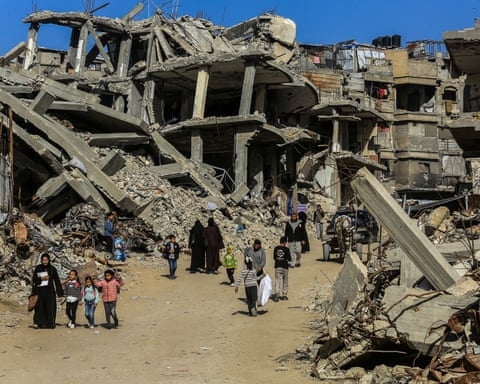
The immediate disarmament of Hamas should not be the primary objective for the planned international stabilization force in Gaza, according to Turkey’s top diplomat. Instead, Foreign Minister Hakan Fidan has stated that the initial and most urgent task should be to establish a clear separation between Israeli military units and Palestinian fighters.
Speaking from Doha, Fidan emphasized a need for a realistic and orderly approach. He argued that the force’s first mission must be to create a buffer, effectively distancing Palestinian civilians and combatants from Israeli troops. This stance was echoed by Egypt’s foreign minister, who called for the rapid deployment of monitors along the central demarcation line in Gaza to independently verify ceasefire compliance and report violations.
Discussions regarding the force’s composition and mandate have reportedly reached an impasse. A key point of contention is Israel’s insistence on the group’s disarmament as a precondition for its own withdrawal, a sequence several nations find problematic. Norway’s foreign minister warned of the current ceasefire’s fragility, stating that the region faces a critical choice between advancing a peace structure or risking a descent back into full-scale conflict or lawlessness.
Further complicating the matter is the question of which nations will contribute troops. While countries like Indonesia and Azerbaijan have expressed willingness to participate, diplomatic sources suggest they would prefer Turkey to be a member of the force—a prospect Israel opposes.
The debate extends to the ultimate recipient of any surrendered weapons. Several nations have proposed that disarmament, when it occurs, should be to a reconstituted Palestinian Authority, not directly to the international force, to avoid the symbolism of a surrender to an external entity. This proposal, however, was not accepted by the United States in earlier draft resolutions.
Qatar’s foreign ministry spokesperson cautioned that forcibly disarming one group without resolving the underlying political crisis could be a temporary solution, potentially leading to the emergence of new armed factions. The sentiment was underscored by a warning from Saudi Arabia’s foreign minister, who stated that lasting security for all parties is impossible without the establishment of a sovereign Palestinian state.
In a related statement, a senior Hamas official indicated the group would reject any international force whose core mission is to disarm it by force. He stated a conditional acceptance of UN forces solely for border monitoring and ceasefire observation.
Amid these complex negotiations, Turkish Foreign Minister Fidan outlined a proposed sequence: first, a committee of Palestinian experts should assume civilian administration in Gaza, followed by the formation of a new, non-partisan Palestinian police force to restore public security. He acknowledged that diplomatic efforts may be experiencing delays due to external factors but affirmed a shared broad objective with key international partners.
Concluding the calls from the region, Qatar’s Prime Minister asserted that a sustainable ceasefire is contingent upon a full Israeli military withdrawal and the restoration of freedom of movement for Gaza’s population.