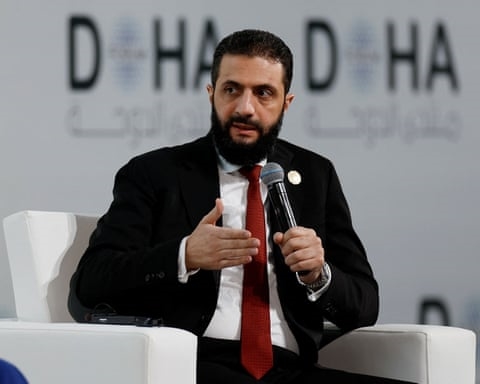
In a sharp critique of ongoing regional hostilities, Syria’s interim leader has characterized Israel’s military operations as a battle against “phantoms,” arguing that the nation uses security concerns to justify aggression beyond its borders. The remarks were delivered at an international forum in Doha this weekend.
The comments come against a backdrop of sustained aerial bombardments and ground incursions by Israeli forces into southern Syrian territory. The Syrian official emphasized his administration’s repeated calls for adherence to a decades-old disengagement pact, warning that attempts to alter the agreement’s terms—including proposals for a demilitarized zone—risk provoking severe and unpredictable consequences.
Israeli military units have operated within a UN-supervised buffer area in the Golan Heights for approximately a year, with operations increasingly extending further into Syria. This has reportedly heightened insecurity for communities in the regions south of the capital.
The Syrian leader asserted that, since assuming office, his government has consistently communicated a desire for regional peace and stability. He accused Israel of leveraging its conflict with Gaza-based militants to rationalize a broader campaign, stating the country has “morphed into an exporter of crises” that projects its internal security narrative onto all surrounding events.
Syrian authorities cite a high volume of Israeli airstrikes and hundreds of cross-border incursions over the past year, with a recent deadly attack on a town near Damascus highlighted as a particularly egregious example. The official stated that Syria is coordinating with several influential international partners in diplomatic efforts aimed at pressuring Israel to withdraw from occupied territories, with negotiations reportedly involving a major global power.
The proposal for a demilitarized zone was met with skepticism, with the Syrian side questioning how such an area could be secured without the presence of its national armed forces. Israel maintains that the measure is necessary to prevent infiltration by armed groups and to secure its border.
Addressing domestic affairs, the leader described Syria as a nation in development, referencing recent legislative elections organized for a transitional period. He framed the electoral process as a foundational step toward institutional governance, distancing the state’s future from reliance on individuals. A commitment was made to hold comprehensive national elections within four years.
The speech concluded with a pointed assurance regarding societal safety, suggesting that men, not women, have greater cause for concern in the current climate, though no further elaboration was provided.