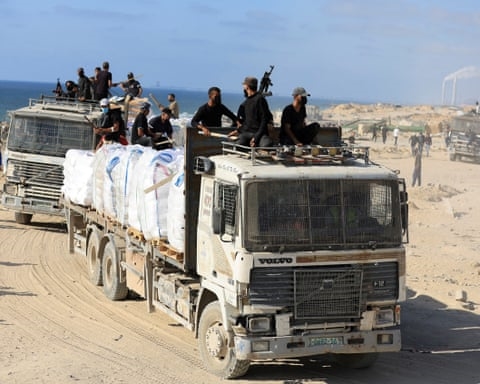
A French historian who spent over a month in Gaza during the recent conflict has presented what he describes as compelling evidence that Israeli forces actively supported groups looting humanitarian aid convoys. Jean-Pierre Filiu, a professor of Middle East studies, entered the territory in December and documented his observations in a recently published account.
Filiu reports witnessing Israeli military actions that directly undermined security for aid shipments. He describes an incident where a United Nations convoy, attempting a new route to avoid theft, came under fire. According to his testimony, Israeli quadcopter drones were seen supporting looters by attacking local security teams hired to protect the trucks. An Israeli airstrike during this event reportedly killed two local figures tasked with guarding the convoy, leading to the partial looting of the aid shipment.
The historian argues that the objective of such operations was to destabilize Hamas’s authority and discredit UN aid efforts. By enabling looters—described by Filiu as Israeli “clients”—to seize supplies, the strategy allegedly aimed to create alternative power networks dependent on redistributed aid or the profits from its resale.
Israeli officials have firmly denied these allegations. A military statement clarified that in the specific incident cited, a precision strike targeted a vehicle containing armed individuals accused of attempting to hijack aid for Hamas. The Israel Defense Forces maintain that their operations comply with international law and are intended to facilitate, not obstruct, the delivery of humanitarian assistance to Gaza’s civilian population.
These claims align with internal UN assessments from the period, which noted Israel’s “passive, if not active benevolence” toward gangs involved in looting. Filiu further alleges that Israeli forces bombed a newly established alternative aid route planned by the World Food Programme, deliberately rendering it unusable.
During the war, Israel maintained strict controls over aid entering Gaza and has consistently accused Hamas of systematically diverting assistance for its own military and financial purposes—a charge Hamas denies. While Israeli leadership has acknowledged providing support to certain local anti-Hamas factions, it rejects accusations of intentionally hindering aid distribution or backing criminal looters.
Having visited Gaza for decades, Filiu expressed profound shock at the scale of destruction wrought by the conflict, stating that much of what previously existed had been “erased.” He warned that the situation in Gaza represents a broader, alarming precedent—a “universal tragedy” testing the limits of international humanitarian norms and conventions in modern warfare.