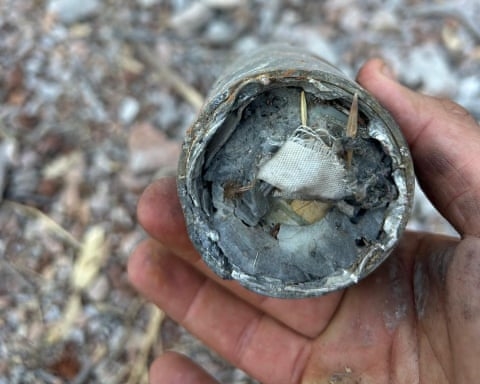
New evidence has emerged indicating the Israeli military employed internationally banned cluster munitions during its recent conflict in Lebanon. Photographic documentation of weapon remnants, analyzed by multiple independent arms experts, suggests the use of these controversial weapons for the first time in nearly two decades.
The images depict remnants of two specific types of advanced cluster munitions, identified as the 155mm M999 Barak Eitan and the 227mm Ra’am Eitan guided missiles. These were reportedly found in several forested valleys in southern Lebanon. If confirmed, this would mark the first known deployment of these newer munition models.
Cluster munitions are widely condemned due to their indiscriminate nature. The weapons disperse numerous smaller bomblets over a broad area, and a significant percentage often fail to detonate on impact. These unexploded remnants effectively become landmines, posing a lethal threat to civilians for years, even decades, after a conflict ends. A total of 124 nations are party to an international convention prohibiting their use, production, and transfer, though Israel is not among the signatories.
In response to inquiries, the Israeli military stated it “uses only lawful weapons, in accordance with international law,” but did not directly confirm or deny the use of cluster munitions.
The findings carry particular weight in Lebanon, a nation still scarred by the legacy of previous cluster munition use. During the final days of the 2006 war, Israel dropped millions of cluster bombs on Lebanese territory. An estimated one million failed to explode initially, and these remnants have caused hundreds of civilian casualties in the years since, a primary catalyst for the creation of the 2008 international ban.
Weapons experts who reviewed the new evidence noted that the identified munitions are recent developments, reportedly engineered to have lower failure rates. However, analysts caution that manufacturer claims about reliability are often not borne out in real-world conditions. They emphasize that the fundamental characteristic of cluster munitions—their wide-area effect—makes distinguishing between military targets and civilians virtually impossible at the time of use, while their legacy of unexploded ordnance creates long-term humanitarian hazards.
The discovery of these remnants in heavily wooded areas of southern Lebanon aligns with military tactics historically used to target dispersed forces in dense terrain. The ongoing danger posed by such weapons, experts argue, underscores why the majority of the world’s nations have moved to outlaw them entirely.