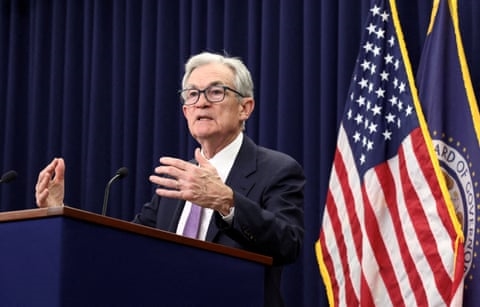
The Federal Reserve reduced its key interest rate by a quarter of a percentage point on Wednesday, a move that revealed notable disagreement among policymakers as they navigate an economy facing conflicting pressures.
The decision lowers the federal funds rate to a target range of 3.5% to 3.75%. While framed by leadership as a consensus-driven action, the 9-3 vote by the rate-setting Federal Open Market Committee was unusually split, signaling internal debate over the appropriate path forward.
This divergence underscores the complex landscape confronting officials. Recent economic readings present a mixed picture: inflation has edged higher in recent months, while the unemployment rate has also seen a modest uptick. These concurrent increases create a policy dilemma, where easing monetary policy too aggressively could fuel price pressures, but maintaining restrictive settings risks weakening the labor market.
Compounding the challenge is a significant gap in official economic data, stemming from the recent federal government shutdown which halted the collection of key statistics on prices and employment. In remarks following the announcement, the Fed Chair acknowledged that officials must now interpret incoming information with caution, noting that some figures may not fully reflect current underlying conditions.
External factors, including international trade policies, were cited as adding to the economic uncertainty and contributing to inflationary trends. The central bank’s communications indicated a potential pause in further rate reductions in the near term, suggesting a wait-and-see approach as these dynamics unfold.
The political environment adds another layer of complexity. The administration has consistently voiced a preference for lower borrowing costs. Furthermore, the term of the current Fed Chair concludes in the spring, opening the possibility for a leadership change at the world’s most influential central bank. Speculation about a potential nominee has begun, though no official selection has been confirmed.
When questioned about his tenure, the outgoing Chair expressed a primary goal of handing over an economy in solid condition to his successor. The coming months will test the institution’s ability to steer through data limitations, policy disagreements, and shifting political winds.