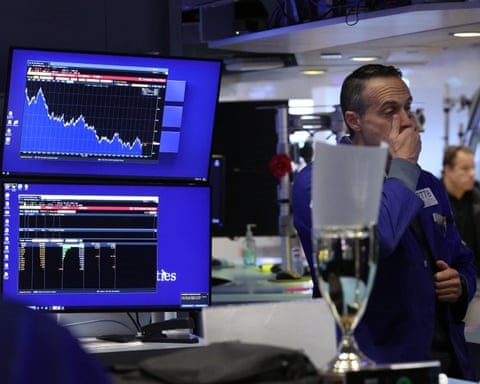
A sharp downturn swept through global financial markets on Friday, driven by a significant sell-off in the technology sector and renewed anxieties over the health of the Chinese economy. The declines followed a difficult session on Wall Street and were mirrored across European and Asian trading floors.
In the United States, major indices faced sustained pressure. The technology-heavy Nasdaq Composite fell sharply, at one point dropping nearly 2%, while the broader S&P 500 and the Dow Jones Industrial Average also posted notable losses. The sell-off was led by major players in the artificial intelligence and semiconductor space, with notable declines for industry giants as investors reassessed soaring valuations. This reassessment was reportedly triggered in part by a major shareholder divesting its entire stake in a leading AI firm.
The negative sentiment crossed the Atlantic, where London’s FTSE 100 index fell over 1%, erasing recent gains that had brought it close to a historic milestone. Banking stocks were among the hardest hit. Similar losses were recorded across continental Europe, with key indices in Germany and France also moving lower.
Simultaneously, markets reacted to fresh economic data from China indicating a pronounced slowdown. Figures revealed a record contraction in fixed-asset investment over a ten-month period, signaling deeper-than-expected weakness in the world’s second-largest economy. This contributed to declines in major Asian benchmarks, including indices in Hong Kong and Taiwan, which all closed in negative territory.
Analysts point to a confluence of factors behind the volatility. Beyond the tech valuation concerns and Chinese data, investor uncertainty persists regarding the timeline for potential interest rate cuts by the U.S. Federal Reserve. Recent commentary from officials has suggested a more cautious approach, leading markets to dial back expectations for monetary policy easing in the near term.
The market turbulence also impacted currency and bond markets. The British pound weakened against the U.S. dollar, a move attributed in part to domestic fiscal policy developments after the government abandoned a planned tax increase.
The widespread declines underscore a fragile period for global markets, as participants grapple with high valuations in key sectors, geopolitical tensions, and mixed signals on the trajectory of major economies.