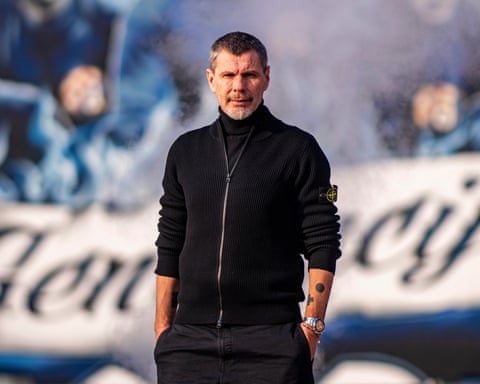
The mist over Maksimir Stadium seems fitting. Inside the club’s offices, Zvonimir Boban is explaining his homecoming. The former midfield maestro, now president of Dinamo Zagreb, is eating in a canteen that was once his dormitory. For him, this is not just a job; it is the culmination of a lifetime’s loyalty.
“If I didn’t do this,” he states, “it would be a betrayal of every value I have lived for.”
His return to the club he captained as a teenager is a stark contrast to his previous roles in the corridors of power at FIFA and UEFA. He left the latter in a blaze of principle nearly two years ago, resigning over proposed statute changes that would extend the presidency of Aleksander Čeferin. The personal relationship is damaged, but Boban has no regrets about his stand.
His critique extends to his former colleague at FIFA, Gianni Infantino. He describes Infantino’s recent actions, such as presenting a “peace prize” to a former U.S. president during a World Cup draw, as “disrespectful, irresponsible, and shameful.”
“He isn’t aware of what he is doing to himself and FIFA now,” Boban says. “Thinking to do the best, but doing completely the opposite. It shouldn’t be a political organisation.”
Boban remains a defender of the work done to reform FIFA’s integrity and is a staunch advocate for VAR, arguing it has made match-fixing far more difficult. However, he is scathing about the current direction of the game’s governance, particularly the expanded 32-team Club World Cup format. “Thirty-two teams and 30 days, you are killing the players,” he concludes.
His focus now is entirely on Dinamo. He is rebuilding the club without a salary, aiming to cleanse it of past scandals and establish one of Europe’s finest youth academies. He has recruited expertise from Barcelona’s famed La Masia and believes Dinamo can become a crucial developmental stepping stone for top talents.
When asked if he misses the influence of his old roles, his answer is definitive. This, he says, is his first and last football station. The emotion here is unmatched.
The conversation inevitably turns to 1990, when his iconic kick at a policeman during a riot at Maksimir made him a symbol of Croatian defiance. He downplays his individual role, framing it as a collective act of a generation seeking justice and freedom, not nationalism.
A historian by education, Boban reflects that human nature—our doubts and fears—hasn’t changed since ancient times. But his own nature is immutable.
“You can read a million books,” he smiles, “but I’m a football player in my soul.”
He still occasionally trains with the academy’s youth teams, the knees protesting but the spirit willing. In many ways, he explains, he is still that four-year-old boy whose only mission was to play the game. Now, his mission is to restore the heart of his first club.