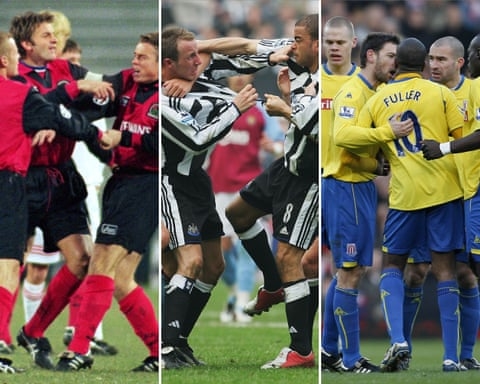
The recent incident involving Idrissa Gueye’s dismissal for striking his own teammate, Michael Keane, has sparked a broader conversation about the rare but dramatic phenomenon of players clashing with their own colleagues during a match. While such events are infrequent, football history holds several notable examples where internal frustrations have boiled over in public view.
Some of the most infamous cases date back decades. In the late 1970s, Charlton Athletic strikers Derek Hales and Mike Flanagan were both sent off after trading blows during an FA Cup tie, a dispute reportedly rooted in on-pitch disagreements over passing. Years later, in 1994, Hearts defenders Craig Levein and Graeme Hogg were dismissed from a pre-season friendly after a fistfight, with Levein reportedly breaking Hogg’s nose.
The Premier League era has seen its own share of internal conflicts. Perhaps the most memorable occurred in 2005, when Newcastle United’s Lee Bowyer and Kieron Dyer engaged in a physical altercation during a match against Aston Villa, both receiving red cards. They were joined in this dubious category by Stoke City’s Ricardo Fuller, sent off for hitting captain Andy Griffin in 2008, and now, Idrissa Gueye. These four remain the only players to be shown a red card for violent conduct against a teammate in the competition’s history.
Other incidents have stopped short of a dismissal but captured significant attention. A heated argument between Liverpool’s Bruce Grobbelaar and Steve McManaman in the 1990s, or Aston Villa’s Anwar El Ghazi clashing heads with Tyrone Mings in 2019, demonstrate that tensions can flare without official sanction. More recently, in 2021, Galatasaray’s Marcão was sent off after an aggressive confrontation with teammate Kerem Akturkoglu in the Turkish Süper Lig.
These moments, though often brief, reveal the intense pressure and high emotions inherent in professional football, where the line between competitive fire and outright conflict can sometimes vanish in an instant.