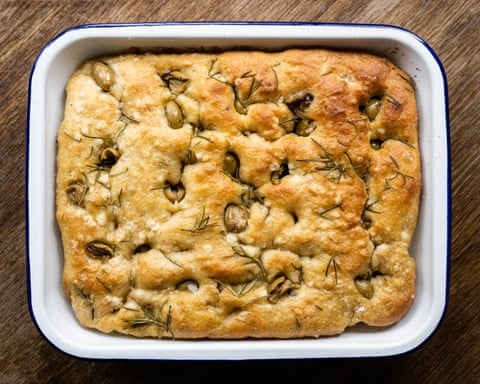
That leftover liquid from a jar of olives is far from waste. It’s a concentrated source of savory, umami-rich flavor, a versatile kitchen staple that deserves a place beyond the rim of a cocktail glass. One of its most transformative uses is in baking, where it can create a focaccia with an exceptionally flavorful and aromatic crust.
The technique involves creating a salamoia—a simple emulsion of the olive brine and good olive oil. This mixture is drizzled over the dough just before baking, where it bakes into the surface, imparting a deep, salty complexity and a beautiful finish. It’s a brilliant way to add a gourmet touch and reduce food waste in one step.
This recipe utilizes a high-hydration dough, which results in a light, airy crumb with a satisfyingly crisp exterior. While traditional white flour works perfectly, incorporating a small percentage of wholemeal flour (around 15-20%) adds a subtle nuttiness and extra nutritional value without compromising the bread’s classic texture.
For the Salamoia (Crust Topping):
30 ml olive brine (at room temperature)
30 ml extra-virgin olive oil
Flaky sea salt for finishing (optional)
For the Dough:
500 g flour (a blend of mostly white bread flour with 75-100 g wholemeal flour, if desired)
5 g (about 1 ½ tsp) active dry yeast
1 tbsp sugar or honey
5 g fine sea salt
2 tbsp extra-virgin olive oil, plus more for the pan
Approximately 425 ml warm water
Optional Toppings:
Fresh rosemary leaves
Pitted olives
Method:
1. Prepare the Salamoia: In a small bowl, vigorously whisk together the olive brine and 30 ml of olive oil until they form a loose, emulsified mixture. Set aside.
2. Make the Dough: In a large mixing bowl, combine the flour and yeast. Create a well in the center and pour in the warm water, sugar (or honey), 5g of sea salt, and 2 tablespoons of olive oil. Mix until a shaggy dough forms. Knead by hand or with a dough hook for about 5-7 minutes until smooth and elastic. The dough will be quite sticky due to the high hydration.
3. First Rise: Cover the bowl with a damp cloth or plastic wrap and let the dough rest at room temperature for about 20 minutes.
4. Shape: Generously oil a 23cm x 33cm (or similar) baking tray. After the brief rest, perform a series of folds: gently lift one edge of the dough and fold it into the center. Repeat around the entire dough to create tension. Transfer the dough, seam-side down, to the oiled tray. Drizzle a little more oil over the top and, using oiled fingertips, gently press and stretch the dough to fit the pan. Cover again and let rise in a warm place for 60-90 minutes, or until nearly doubled in size.
5. Final Dimpling and Topping: Preheat your oven to 200°C (180°C fan)/390°F. Once risen, scatter over any optional toppings. Press deep dimples all over the surface of the dough with oiled fingers. Drizzle the prepared salamoia evenly across the entire surface, letting it pool in the indentations. Let the dough rest for 15-20 minutes while the oven finishes heating.
6. Bake: Place the tray in the preheated oven and bake for 25-30 minutes, until the focaccia is deeply golden brown and sounds hollow when tapped on the bottom. Transfer to a wire rack to cool slightly before serving.