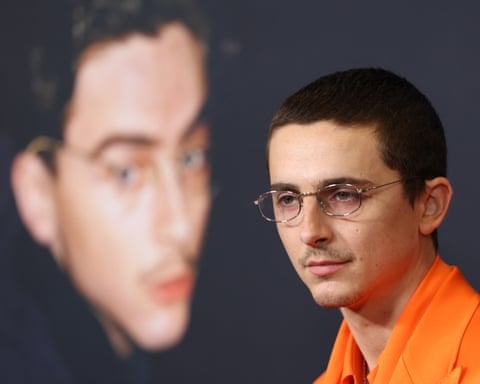
In an era where movie marketing often feels repetitive and predictable, one actor’s relentless and eccentric promotional campaign has broken the mold. Timothée Chalamet’s efforts to promote the 1950s-set ping-pong epic Marty Supreme have turned the traditional press tour into a spectacle of creativity and sheer commitment.
The campaign kicked off unexpectedly in mid-November with a video posted to Chalamet’s social media. Presented as a leaked Zoom call, the clip showed the actor pitching increasingly absurd marketing ideas to a fictional studio team. What began as a satire of desperate promotional tactics quickly became a real-world strategy—one that embraced audacity over polish.
Since then, the promotional efforts have been anything but ordinary. From pop-up screenings featuring bodyguards with giant orange ping-pong ball helmets to a near-silent livestream that turned a simple phrase into a viral mantra, the campaign has consistently captured public attention. High-profile figures across sports, science, and the arts have been enlisted to wear branded jackets in a “dream big” ad series, while a bright orange blimp hovered over Los Angeles. Even a Las Vegas landmark was temporarily lit in a distinct rust hue as part of the push.
This unconventional approach appears to be paying off. In limited early releases, Marty Supreme achieved the highest per-theater average opening in nearly a decade—a promising sign for a film with a substantial budget. Its success stands in stark contrast to a year marked by underperforming original films featuring major stars, many of which struggled to draw audiences despite extensive traditional promotion.
The broader landscape for original cinema remains challenging, with franchises and streaming dominating viewer attention. Yet Marty Supreme’s campaign highlights a shifting reality: in today’s saturated media environment, surprise and memorability are becoming essential. While there’s no guaranteed formula for success, innovation and volume of effort seem to be key.
Chalamet has framed his energetic approach as a mission to support original, independent cinema. In interviews, he has spoken directly about the difficulty of convincing audiences to choose the theatrical experience in an age of short attention spans and instant streaming. His strategy leans into full engagement, using his platform to advocate for the cultural importance of seeing films in theaters.
Whether this high-energy campaign will translate into lasting box-office success remains to be seen. But it has undoubtedly refreshed the playbook for film promotion—blurring the lines between marketing, performance, and advocacy. In a time when originality on-screen is fighting for visibility, originality off-screen may be one of its strongest allies.