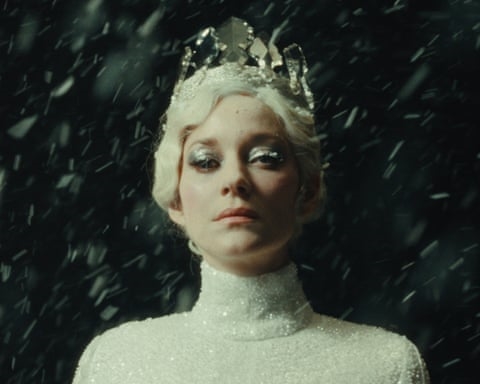
In the landscape of contemporary cinema, few filmmakers craft worlds as singular and unsettling as Lucile Hadžihalilović. Her latest feature, The Ice Tower, continues this tradition, weaving a haunting fable around the dangerous magnetism of fantasy and idolatry.
The narrative follows Jeanne, a teenage orphan who flees her life to infiltrate the set of a film adaptation of Hans Christian Andersen’s “The Snow Queen.” On this soundstage, a realm governed by its own arcane rituals, she encounters the production’s star: the formidable and imperious actress Cristina van der Berg. Through Jeanne’s awestruck perspective, the mechanics of filmmaking itself become a hermetic, almost sacred universe.
Drawn into Cristina’s orbit, Jeanne willingly becomes a protégé, blurring the lines between admirer and acolyte. The film masterfully intertwines scenes from the fairy-tale shoot with Jeanne’s own reveries, creating a disorienting limbo where artifice and reality, longing and truth, become indistinguishable. This is not a story of wish fulfillment, but a stark warning. The fantasy Jeanne chases—whether seeking a mother, a muse, or a version of herself—carries a profound psychic cost.
Set against an indistinct, retro backdrop, the film serves as an allegory for the perils of immersion in any crafted illusion, a theme resonating deeply in an age saturated with digital imagery. The central performance is a study in controlled, glacial power, portraying a figure whose glamour is inseparable from her isolation and latent damage.
Beneath its icy surface, The Ice Tower simmers with potent questions. Is the true monster the object of obsession, the machinery of art that ensnares it, or the chilling nature of desire itself? Hadžihalilović offers no easy answers, instead presenting a beautifully crystallized, and ultimately cautionary, vision of what happens when enchantment freezes into fixation.