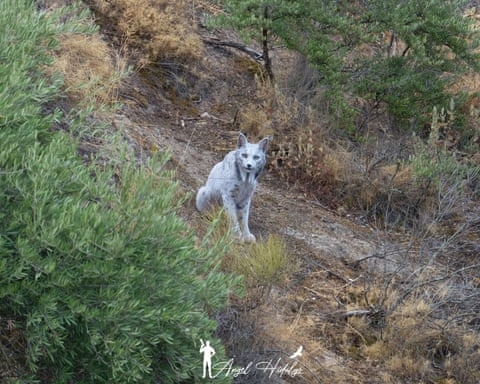
An extraordinary sighting in the woodlands of southern Spain has captivated naturalists and the public alike. An amateur wildlife photographer has successfully documented what appears to be a white Iberian lynx, a phenomenon rarely, if ever, captured on film.
The photographer, who had been patiently monitoring a camera trap for months, finally recorded the animal at dawn following a night of rain. He described the encounter as breathtaking, noting the lynx’s striking pale winter coat and intense gaze—a stark departure from the species’ typical tawny, black-spotted fur.
While the images have sparked widespread fascination, conservation officials note this particular lynx is not unknown to science. Identified as a female named Satureja, born in 2021, she was documented with normal coloration at birth. Her pigmentation changed later in life, a transformation that experts confirm is not due to albinism or leucism, conditions involving a lack of pigment.
Researchers associated with a major lynx conservation project are investigating the cause. Early hypotheses suggest an environmental factor may have triggered a reversible pigmentation change. Intriguingly, a similar case was previously observed in a female from the same area, where the coat colour shifted to white and then reverted to brown, hinting at a possible hypersensitivity.
Authorities plan a brief capture of the lynx to collect samples, hoping scientific analysis will reveal the mechanism behind this colour shift.
The sighting comes amid a celebrated recovery for the Iberian lynx. Once teetering on the edge of extinction, concerted conservation efforts have led to a significant population rebound. Last year, its threat status was officially downgraded from “Endangered” to “Vulnerable” on the global list of threatened species, marking one of European conservation’s most notable successes.