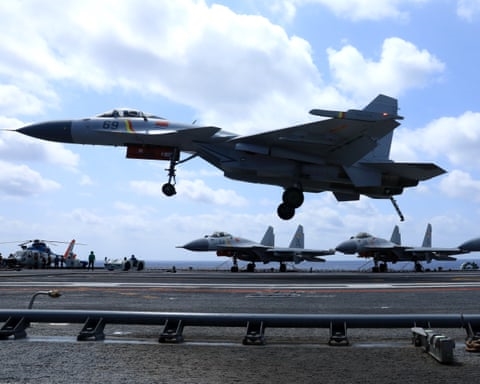
Japanese authorities have formally summoned the Chinese ambassador to Tokyo following a serious military incident over the weekend. The Japanese Ministry of Defense alleges that Chinese fighter jets targeted Japanese aircraft with fire-control radar, an action widely considered a prelude to potential hostilities.
According to a statement released by the defense ministry, the event occurred southeast of Okinawa on Saturday afternoon. Officials claim that J-15 fighter jets, operating from the Chinese aircraft carrier Liaoning, directed their targeting radar systems onto Japanese F-15 fighter jets on two separate occasions. The ministry stated that while no visual confirmation was possible at the distance involved, the electronic detection of the radar lock is a grave matter.
A fire-control radar lock is a significant escalation in military encounters, as it simulates the final step before a missile launch, forcing the targeted aircraft to initiate defensive maneuvers. The Japanese Defense Minister characterized the actions as “dangerous and extremely regrettable,” asserting they exceeded the bounds of necessary safety procedures for flight operations.
In response to the diplomatic protest, Chinese officials have categorically rejected the Japanese account. A spokesperson for China’s Ministry of National Defense countered that Japanese Self-Defense Force aircraft had “maliciously followed and harassed” the Chinese carrier group during a scheduled training exercise. Beijing insists that its military was operating within a pre-announced exercise zone and has accused Tokyo of intruding into the area and fabricating the incident to create regional tension.
This confrontation marks the latest in a series of escalating diplomatic and military frictions between the two nations. Tensions have been heightened recently following remarks from the Japanese leadership concerning potential security contingencies in the Taiwan Strait, which drew a sharp rebuke from Beijing. In apparent retaliation, China has reinstated a ban on Japanese seafood imports and increased military and coast guard activity near disputed East China Sea territories.
The Japanese Prime Minister has vowed a “calm and resolute” response to the radar incident, pledging to enhance maritime and aerial surveillance. The situation underscores the fragile state of relations in a region where such military encounters carry a high risk of miscalculation.