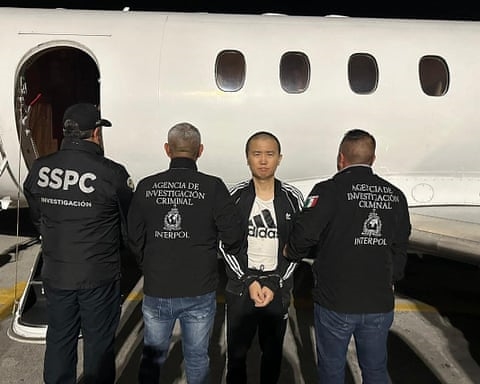
An alleged international narcotics broker, whose dramatic escape and recapture spanned multiple continents, is now on trial in a United States federal court. His case, according to analysts, highlights the increasingly sophisticated and entrenched alliance between Chinese criminal networks and Mexico’s powerful drug cartels.
The defendant, Zhi Dong Zhang, also known by aliases including “Brother Wang,” faces serious charges in a Brooklyn courtroom. Federal prosecutors allege he orchestrated the smuggling of multi-ton quantities of chemical precursors used to manufacture fentanyl for Mexico’s Sinaloa and Jalisco Cartels. Additional indictments include trafficking cocaine and methamphetamine, alongside accusations of laundering nearly $100 million through a complex web of U.S.-based shell companies and bank accounts. Zhang has entered pleas of not guilty to all counts.
His path to the courtroom was circuitous. While under house arrest in Mexico City last July, Zhang allegedly escaped through a tunnel into a neighboring property, evading military guards. He then reportedly traveled to Cuba with the apparent aim of reaching Russia, a nation without an extradition treaty with the U.S. This plan unraveled when Russian authorities refused him entry. The Cuban government subsequently announced his arrest and promptly returned him to Mexico, which then extradited him to American custody.
Experts point to the escape as evidence of high-level corruption and the significant value placed on individuals like Zhang within transnational crime. “His facilitation from custody and the arranged private flight suggest powerful protectors,” noted one former narcotics investigator. “He wasn’t just a fugitive; he was a high-value asset being moved.”
Analysts describe Zhang as a pivotal “convergence” figure, deeply embedded in the logistics of both narcotics supply and financial concealment. His cultural fluency and connections in both China and Mexico provided a rare bridge for cartels seeking reliable partners. “He operated at the nexus of multiple critical operations—precursor chemicals, drug trafficking, and massive money laundering,” the former investigator added. “That makes him more valuable than a traditional kingpin confined to a single silo.”
Zhang’s arrest has brought renewed scrutiny to the financial engine of the cartel-China nexus: money laundering. Chinese criminal organizations have developed a highly efficient system that exploits the desire of many wealthy Chinese citizens to move capital abroad, despite strict domestic financial controls.
The process often works as follows: Cartel associates in the U.S. deliver bulk cash from drug sales to Chinese money brokers stateside. Once confirmed, associates of those brokers in Mexico pay the cartels in local pesos. The brokers then sell the now-cleaned U.S. dollars to clients in China who wish to purchase overseas assets, receiving payment in yuan within China. This creates a closed loop where no physical money crosses an international border, complicating law enforcement efforts. The system is so efficient that brokers can charge cartels commissions as low as 1-2%, a fraction of traditional laundering costs.
While Zhang’s extradition provides U.S. authorities a potential intelligence windfall into these interconnected networks, experts caution that his removal is unlikely to significantly disrupt the flow of precursor chemicals or the laundering apparatus for long. The networks are adaptable and the underlying economic drivers—cartels’ need for chemicals and laundered profits, coupled with capital flight from China—remain firmly in place.
The case underscores a stark reality: the battle against synthetic opioids like fentanyl is now a fight against deeply collaborative, globalized criminal enterprises that seamlessly merge the logistical and financial expertise of groups from opposite sides of the world.