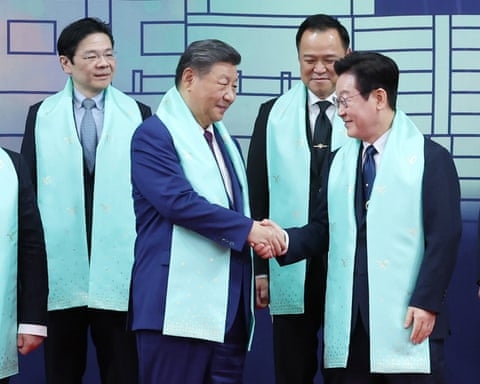
The annual Asia-Pacific Economic Cooperation summit concluded in South Korea, its proceedings overshadowed by a notable absence. As leaders from 21 economies convened, the dominant narrative was set not by those in the room, but by the decision of the U.S. President to depart early, leaving his seat vacant for the core discussions.
This void created an opportunity for others to step forward. The Chinese leader, fresh from a whirlwind regional tour, positioned himself prominently, advocating for open trade and regional economic stability—a stark contrast to the protectionist rhetoric that has recently characterized U.S. policy. While the American delegation participated, the president’s early exit to domestic events shifted the diplomatic center of gravity.
The summit’s tangible outcomes were modest, reflecting the forum’s inherent challenges. After intense negotiations, members issued a broad declaration supporting a “resilient” trade environment, but the statement notably omitted any direct reference to multilateral institutions or specific binding commitments. This underscored APEC’s struggle to find consensus in an era of deepening geopolitical fractures and economic nationalism.
Bilateral diplomacy on the sidelines offered more concrete developments. In a significant move, Canada and China announced a thaw in relations, with an exchange of state visits planned. Analysts suggest this budding rapport may be partly a strategic response by both nations to escalating trade tensions with the United States. The Canadian government framed the dialogue as a potential “turning point.”
The summit also served as an international debut for Japan’s new prime minister. In a series of carefully managed meetings, she balanced affirmations of strategic partnerships with regional neighbors against firm statements on security concerns, navigating a complex diplomatic landscape without major misstep. Her performance suggested a pragmatic approach to foreign policy, despite her conservative domestic reputation.
Ultimately, the gathering in Gyeongju highlighted a regional order in flux. The forum, conceived in an age of globalization, now operates in a climate of strategic competition. The most lasting image may be that of an unoccupied chair, symbolizing a recalibration of influence and alliances across the Pacific. The summit did not resolve the era’s great tensions, but it vividly mapped their new contours.