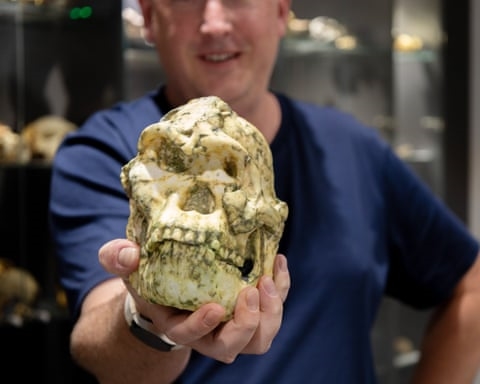
A groundbreaking analysis of one of the most complete early human fossils ever discovered suggests it may belong to a previously unknown species, potentially adding a new branch to our complex evolutionary history.
The fossil, famously nicknamed “Little Foot” for the foot bones first identified in 1994, was meticulously excavated over two decades from the Sterkfontein caves in South Africa. Publicly revealed in 2017, the near-complete skeleton has long been a subject of scientific debate. Some experts classified it as Australopithecus africanus, a species known from the same cave system, while its discoverer attributed it to a separate species called Australopithecus prometheus.
Now, a new study presents a compelling third option. Researchers have concluded that Little Foot’s anatomical features are distinct from both proposed species. The key differences were found in the base of the skull, a region considered evolutionarily stable and slow to change.
“The back of the skull is an area that tends to be conserved. When you find significant differences there, it’s a stronger indicator you’re looking at separate species,” explained the lead researcher. “All the distinguishing traits we identified are in that critical region.”
The findings imply that Little Foot could represent a distinct lineage of hominins—the group that includes modern humans and our extinct ancestors. “This isn’t just a new point on the family tree we hadn’t found,” the researcher noted. “It could be an entire limb of that tree we didn’t know existed.”
The research team has stopped short of formally naming a new species, stating that honor should go to the scientists who dedicated over twenty years to recovering and studying the extraordinary specimen. They have, however, presented their analysis as well-intentioned evidence for reconsideration.
The fossil’s exact age also remains a point of academic discussion, with estimates ranging significantly. Despite these unresolved questions, the study underscores that one of the most iconic fossils in the human ancestral record may hold secrets that continue to reshape our understanding of where we come from.