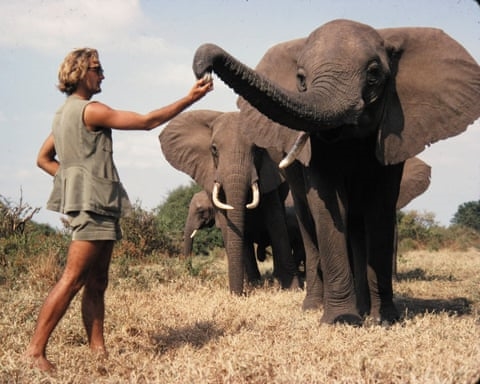
A renowned figure in wildlife conservation, whose groundbreaking work fundamentally shaped our understanding and protection of the African elephant, has passed away at the age of 83. His life’s mission began over half a century ago, driven by a profound connection to these majestic creatures.
In the mid-1960s, as a young graduate and newly licensed pilot, he embarked on an unprecedented study in Tanzania’s Lake Manyara National Park. Faced with the challenge of an overcrowded elephant population, he immersed himself in their world for five years. His pioneering method involved learning to identify each elephant individually, marking the first systematic research into their complex social structures in the wild. This demanding work was not without peril, involving close encounters that required quick escapes and demonstrated his deep respect for their untamed nature.
It was during this period that he met his future wife, who shared his passion and collaborated on documenting their life among the elephants. Their work together brought the animals’ plight and beauty to a global audience.
His research led him to a critical conclusion: safeguarding the elephants’ ancient migratory routes was essential for their survival. However, this mission was soon overtaken by a more urgent crisis. A dramatic surge in the international ivory trade, fueled by soaring prices, triggered a wave of industrial-scale poaching that swept across the continent. By the late 1980s, aerial surveys he coordinated revealed a devastating truth—elephant populations had been halved in just ten years, a decline he termed one of the greatest wildlife tragedies of the modern era.
His relentless advocacy and irrefutable data proved instrumental in turning the tide. The evidence he helped compile exposed the illegal origins of most ivory stocks and created overwhelming pressure for action. This culminated in a landmark international ban on the commercial ivory trade in 1990, a decisive measure that granted the species a crucial respite from the brink.
Seeking long-term solutions, he later established a conservation organization in northern Kenya dedicated to securing a future where elephants and local communities could thrive together. There, he innovated the use of satellite tracking technology to monitor herds, a vital tool for preventing conflict and enhancing protection.
His commitment never wavered, even following a serious encounter with an elephant in 2008 from which he remarkably escaped with minor injuries. His death followed an unrelated incident.
He is remembered not only as a preeminent scientist but as a tireless defender whose work altered the fate of a species. He leaves behind his wife, two children, and six grandchildren. His legacy endures in every herd that roams protected, a testament to a lifetime of unwavering dedication.