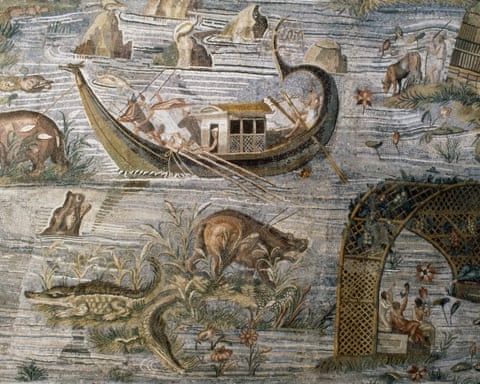
A remarkably preserved ancient Egyptian vessel, identified as a luxury pleasure boat used by the royal court, has been located on the seabed near Alexandria. The discovery provides a tangible link to historical accounts of opulent maritime life in the early Roman period of Egypt.
The wooden ship, measuring approximately 35 meters in length and 7 meters in width, was found in the submerged remains of the ancient Portus Magnus, close to the sunken island of Antirhodos. Its design, featuring a flat bow and rounded stern, suggests it was built for navigation in shallow coastal waters. The structure indicates the presence of a central, lavishly decorated cabin or pavilion, intended for leisure and ceremonial use.
The find corresponds to descriptions left by classical historians of ornate “cabin-boats” employed for royal excursions and festive processions along the Nile Delta canals. These accounts describe vessels filled with music, dancing, and revelry.
The archaeological team investigating the site believes the boat likely dates to the first half of the first century AD. One leading hypothesis is that it sank during a series of catastrophic earthquakes and tidal waves around AD 50, which caused significant portions of the ancient coastline and its structures to collapse into the sea. An alternative theory posits that the vessel may have served as a sacred barge connected to the nearby Temple of Isis, potentially used in religious ceremonies honoring the goddess as protector of the seas.
This wreck represents the first physical example of such a pleasure craft ever found in Egyptian waters, offering a new archaeological benchmark. Previously, knowledge of these ships came solely from textual references and artistic depictions, such as mosaics.
The decision has been made to leave the substantial wooden remains in situ on the seabed, in accordance with best practices for preserving underwater cultural heritage. Research is ongoing, with further excavation planned. Scholars note that the vessel is poised to yield significant insights into the maritime traditions, religious practices, and displays of luxury in early Roman Egypt.