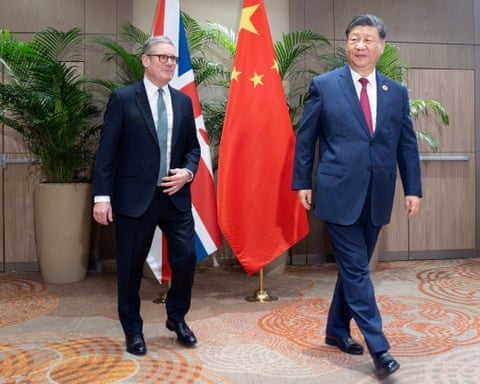
British Prime Minister Keir Starmer has embarked on a significant diplomatic mission to China, aiming to establish what his government terms a “stable and clear” bilateral framework. This visit, the first by a UK premier in nearly a decade, seeks to move beyond what officials have characterised as a period of inconsistent policy. However, the ambition for enhanced cooperation faces immediate tests from a series of entrenched geopolitical and human rights challenges.
A primary and sensitive issue is the status of British citizen Jimmy Lai, the imprisoned Hong Kong media figure. The UK government has formally denounced his recent conviction on national security charges as politically motivated, with the Foreign Secretary demanding his release. With concerns mounting over Lai’s health, there is considerable domestic pressure on Starmer to advocate forcefully on his behalf. The situation of the Uyghur minority is also anticipated to be a point of discussion, given longstanding international allegations of human rights abuses.
The question of Taiwan presents another delicate diplomatic tightrope. While the United Kingdom adheres to the One-China policy and does not maintain formal diplomatic ties with Taipei, China’s increased military and political pressure on the island has raised global tensions. Intelligence assessments suggesting a potential military timeline add urgency to Western calls for peaceful resolution. The UK delegation is expected to handle this topic with considerable caution to avoid derailing broader talks.
In a move seen as a diplomatic gesture ahead of the visit, the UK government recently granted final approval for a new, large-scale Chinese embassy complex in London. The project, delayed for years amid security concerns from lawmakers about its proximity to critical infrastructure, was approved after intelligence agencies advised that associated risks could be mitigated. The decision is viewed as a potential bargaining chip for securing Chinese cooperation on much-needed renovations to the UK’s own embassy facilities in Beijing.
Security tensions extend beyond embassy walls. Authorities have repeatedly warned of persistent Chinese espionage activities targeting British parliamentarians, institutions, and critical national infrastructure. The government asserts it will remain “clear-eyed” about these threats, indicating that such concerns will be part of frank discussions. Starmer is also expected to urge Chinese leadership to leverage its influence with Russia to seek an end to the conflict in Ukraine, challenging Beijing’s professed neutrality.
The core objective of the trip remains economic. The Prime Minister is accompanied by a substantial delegation of business and cultural leaders, underscoring a focus on trade and investment. A key goal is to secure Chinese investment in vital UK industries, such as steel. However, the UK’s relative economic weight means it must work to elevate its importance on Beijing’s agenda, especially as China prioritises relationships with larger trading blocs.
The geopolitical context adds a further layer of complexity. With the United States adopting an increasingly unpredictable stance under the Trump administration, evidenced by recent aggressive trade threats against allies engaging with China, European nations are recalculating their approaches. Starmer’s reported rapport with the US President will be watched closely, as will the outcomes of his talks in Beijing, which are seen as a test of the UK’s ability to balance its security concerns with its economic ambitions on the world stage.