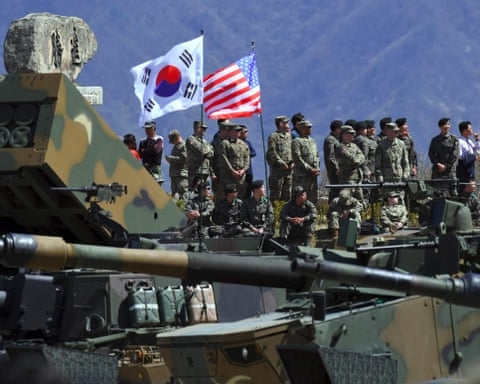
A newly released U.S. defense strategy indicates a significant recalibration of American military priorities, foreseeing a reduced direct role in countering North Korea while calling on South Korea to assume the primary burden of deterrence against its northern neighbor.
The policy document, which outlines the Pentagon’s strategic vision, states that South Korea is now positioned to take the lead in deterring Pyongyang, with the United States providing “critical but more limited” support. This proposed shift in responsibility aligns with what the document terms an American interest in modernizing its military posture in the region.
The announcement is likely to prompt careful analysis in Seoul, which hosts approximately 28,500 U.S. troops under a longstanding mutual defense framework. In recent years, South Korea has substantially increased its own defense capabilities and budget, aiming for a more autonomous defense posture and eventual wartime operational control of combined allied forces.
While South Korea’s defense ministry has reiterated that the U.S. military presence remains central to the alliance, the American strategy reflects a broader focus on defending the U.S. homeland as its top priority. Within the Indo-Pacific, the document identifies countering Chinese military dominance as a key objective, aiming to secure a stable balance of power acceptable to both nations.
Notably absent from the strategy is any explicit call for the denuclearization of the Korean Peninsula, a longstanding formal goal of U.S. policy. This omission suggests a potential strategic adjustment toward managing the reality of North Korea’s nuclear arsenal rather than pursuing its outright elimination.
The policy shift is framed as part of an ongoing modernization of America’s alliance structures. It coincides with a period where U.S. military planners are increasingly focused on a wider range of global challenges, including potential contingencies beyond the Korean Peninsula.