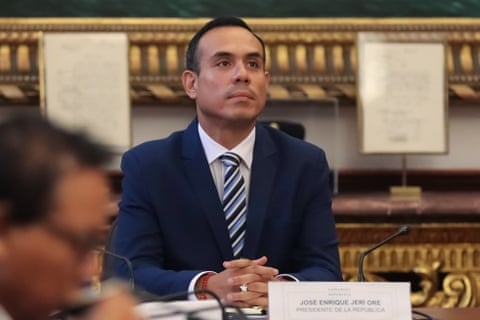
Peru’s interim president, José Jerí, is confronting a severe political crisis and calls for his removal from office following revelations of undisclosed meetings with Chinese businessmen. The scandal, which has captivated the nation, centers on two clandestine encounters that were omitted from the official presidential schedule.
Appearing before a congressional oversight committee, President Jerí, 39, defended his actions, asserting he is the target of a conspiracy aimed at destabilizing the government ahead of national elections scheduled for April. He characterized the situation as a potential “trap” set to undermine him.
The controversy erupted after videos surfaced showing the president in two separate meetings. In one, he is seen with his hood pulled up, and in another, gesturing animatedly during a phone call while wearing dark glasses. Both meetings took place in Lima’s historic Chinatown district—one at a Chinese restaurant and another at a shuttered store.
The primary figure in these meetings was a long-time Peruvian resident of Chinese origin, businessman Yang Zhihua, whom the president refers to familiarly as “Johnny.” Yang oversees a diverse portfolio of local businesses, including retail and energy interests. Also present at the initial restaurant meeting was another Chinese national, Ji Wu Xiaodong, who prosecutors allege is linked to an illicit Amazonian timber trafficking network and had previously been under house arrest. Official logs indicate both men had made several visits to the presidential palace in recent months.
Facing intense public scrutiny, Jerí initially issued an apology when the first video became public, explaining the restaurant meeting was to plan a celebration for Peruvian-Chinese Friendship Day. He expressed regret for the “suspicions” raised by his attire. However, his position weakened hours later with the release of the second video, showing him at Yang’s store, which local authorities had closed for regulatory violations.
Opposition legislators have seized on the affair, announcing their intent to pursue impeachment proceedings against the interim president. They argue the secretive nature of the meetings and the backgrounds of those involved warrant his removal. Despite the controversy, recent polling suggests Jerí maintains an approval rating near 44%, a figure notably higher than his predecessor’s.
The scandal unfolds against a backdrop of intense geopolitical competition in the region. China has solidified its position as a leading trade partner and investor for many Latin American nations, including Peru. A significant symbol of this influence is the modern deepwater port at Chancay, operated by Chinese firm Cosco Shipping Ports since late 2024. In a countermove perceived as challenging Beijing’s growing footprint, the United States recently approved a potential $1.5 billion defense sale to Peru to support the relocation of a key naval base.
Peruvian politics, long characterized by instability and corruption, has seen a tumultuous period with seven different leaders holding the presidency since 2018. As the investigation into “Chifagate” proceeds, the crisis threatens to further disrupt the nation’s fragile political landscape just months before voters head to the polls.