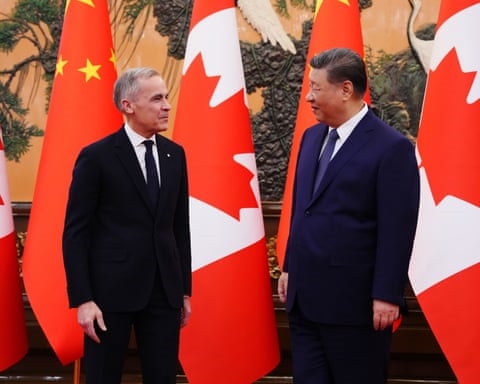
Prime Minister Mark Carney has firmly stated that Canada will not seek a broad free trade agreement with China. The declaration addresses recent international trade tensions and clarifies the scope of a new bilateral arrangement.
The clarification comes in response to statements from U.S. political figures warning against closer Canadian economic ties with Beijing. Carney emphasized that the recent understanding with China is limited, focusing solely on adjusting tariff levels for a select few industries, not establishing a comprehensive free trade framework.
“We have commitments under our continental trade agreement that preclude entering into such pacts with non-market economies without consultation, and we have no intention of doing so with China,” Carney stated. He described the recent tariff adjustments as a corrective measure to resolve specific, recent trade disruptions.
The specific agreement modifies tariffs on electric vehicles and other goods. Under its terms, Chinese EV exports to Canada will face a reduced tariff with an annual import limit, a measure that did not exist prior to 2024. In return, Chinese tariffs on several key Canadian agricultural exports are expected to decrease, with anticipated Chinese investment in Canada’s automotive sector.
Criticism from south of the border has been pointed, with accusations that Canada could become a conduit for Chinese goods into the U.S. market. These comments have injected further strain into the bilateral relationship, which has also been tested by broader geopolitical rhetoric concerning sovereignty and alliances.
Prime Minister Carney has recently positioned himself as a vocal advocate for coordinated action among mid-sized nations on the global stage, arguing for collective strategies to navigate an era of great power competition. This stance has drawn significant international attention and stands in contrast to the current U.S. administration’s unilateral approach.
The situation underscores the delicate balance Canada maintains between its largest trading partner and other significant global economies, all while navigating a volatile international trade landscape.