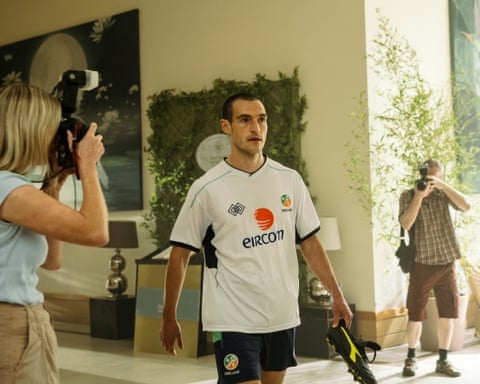
The most compelling sporting moment in the new film Saipan doesn’t occur on a football pitch. Instead, it unfolds on a tennis court. The movie, which dramatizes the explosive rift between footballer Roy Keane and manager Mick McCarthy that saw Keane exit the 2002 World Cup before a ball was kicked, pointedly avoids recreating tournament action. Confined largely to a run-down hotel, the narrative makes one significant exception: a solitary Keane, portrayed by actor Éanna Hardwicke, practicing in the grounds. As a ball arcs toward him, he traps it perfectly with his instep, a brief, wordless testament to his athletic prowess.
Saipan is less a film about football and more an exploration of clashing masculinity, personal pride, and a specific moment in Ireland’s social history. This focus on character over competition may be a shrewd move, given the historically uneven record of football on the silver screen.
“The raw emotion of a live match—the tension that feels like a heart attack—it’s an insane, unique experience,” notes Paul Fraser, the film’s screenwriter. “That intensity is incredibly difficult to translate directly into a film’s structure.” Fraser, a football fan himself, believes the sport offers rich material, but that successful adaptations must look beyond the final score. Stories like Keane’s, he argues, succeed by zooming in on the people, moving past what he calls “the most boring, generalised narrative” of whether a last-minute goal will be scored.
Fraser speaks from experience. An early collaboration with director Shane Meadows began as an attempt at a football film, drawn from their time in a chaotic local team. “It was debauched,” Fraser recalls. “But we found that football, visually, didn’t seem to lend itself to cinema.” That project was ultimately transformed into the boxing film TwentyFourSeven, launching a celebrated chapter in British independent film.
The release of TwentyFourSeven in 1997 coincided with a rising cultural tide for football narratives, a trend scholars link to the sport’s broadening, more middle-class appeal in the Premier League era. Yet, the 21st-century catalogue of football films is littered with critical misfires, from comedic send-ups to earnest dramas. Memorable exceptions, like Bend It Like Beckham, often succeeded by setting their stories apart from the men’s professional game. Meanwhile, documentaries such as those focusing on figures like Zinedine Zidane or Diego Maradona found more compelling ways to capture both personality and sporting action on film.
“Most footballers can’t act, and fans instantly recognize staged match action as fake,” explains one film academic. “There’s an innate grace to top athletes, a poise in every frame, that is nearly impossible to replicate convincingly in scripted drama.”
This leaves football films in a difficult position: unable to perfectly mimic on-pitch drama, yet often scrutinized by a knowledgeable fanbase for factual liberties off it. Saipan has faced some criticism in Ireland for its perceived loosening of historical details, particularly regarding the Irish squad’s conduct. One former international player opened a review with the admonition: “Never let the truth get in the way of a good story.”
Fraser, interestingly, cites the same phrase to explain his creative approach. “I didn’t speak to anyone who was there. It’s a made-up story,” he states plainly. “If I had engaged directly with those involved, seeking their truth, it would have created a different process and potentially bogged the story down. My way in was remembering the image of Keane walking his dog after returning home—a man from a working-class background suddenly living under a global spotlight. That human contrast was what fascinated me.”
The screenwriter’s goal was to craft a story accessible to audiences beyond football fans, focusing on the universal human drama beneath the famous feud. By sidelining the sport itself, Saipan attempts a new play, betting that the most powerful stories in football aren’t found in the stadium, but in the quiet, charged spaces just off the field.