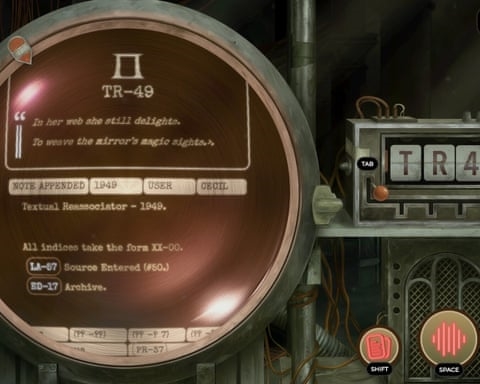
In the shadow of a new British civil war, a different kind of weapon lies hidden. Not a bomb or a gun, but a machine—an arcane device built not for destruction, but for consumption. Its fuel? Books. From dense academic treatises on theoretical physics to the wildest flights of pulp science fiction, this enigmatic creation, known as TR-49, devours the written word. Its purpose, and the secret it guards, could decide the fate of a nation.
Players assume the role of Abbi, a sharp-witted codebreaker tasked with navigating this relocated archive, now buried beneath Manchester. The interface is deceptively simple: input a four-digit code, and you’re instantly transported to a specific page from a specific fictional book. These codes, combinations of author initials and publication years, are the keys to a sprawling, non-linear narrative. The core objective is to catalogue these texts and, ultimately, locate a legendary volume known as Endpeace—a text rumored to hold the ultimate truth about the machine and the war.
The genius of the experience lies in its structure. There is no single path. The mystery is a web, and you can begin pulling any thread. An interest in a fictional physicist’s notes might lead you to a coded reference in a forgotten novel, which in turn points to a philosophical pamphlet. Connections emerge organically, creating a uniquely personal investigation that feels less like solving a preset puzzle and more like genuine scholarly deduction. The game provides a digital notepad, but having physical pen and paper at hand is a wise choice for mapping the cascading revelations.
While the central archive is a masterpiece of interactive storytelling, the framing narrative feels less assured. Radio conversations with Abbi’s handlers, meant to provide context about the conflict and her mission, often lack the depth and intrigue of the textual mystery itself. The broader war remains frustratingly abstract, a faint backdrop to the richly detailed literary detective work.
At its heart, this is a game about the awe and terror of knowledge. It channels a profound ambivalence toward the 20th century’s scientific leaps, wondering not just what we discovered, but what those discoveries did to our perception of reality. It transforms complex ideas into a captivating playground of speculation and mystery.
The initial feeling of being overwhelmed by the archive’s sheer volume quickly gives way to a thrilling sense of fluency. Over the course of several sessions, the joy comes from total immersion—leaping from one text to another, following hunches, and watching the hours slip away. Every water-stained journal or rare edition feels like it could be the final piece of the puzzle, yet the full picture only emerges from the whole. Just as the machine’s creator was ensnared by this collection, so too is the player, drawn into a deeply compelling and brilliantly constructed literary labyrinth.