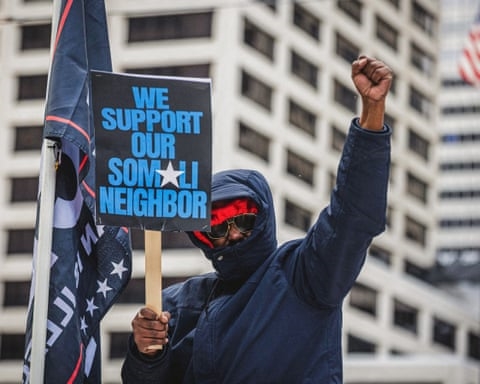
The political climate in the United States has placed a distinct and intense focus on its Somali-American community, creating an atmosphere of anxiety and resilience. This scrutiny, emanating from the highest levels of federal power, leverages the community’s identity to advance a broader anti-immigration agenda, with profound effects on daily life.
Central to this dynamic is a fixation on Minnesota, home to the nation’s largest Somali population. Rhetoric from the administration has repeatedly singled out this community, using derogatory generalizations about both Somali-Americans and their country of origin to justify restrictive policies. This targeting appears amplified by political animus toward specific figures, translating personal vendettas into collective punishment. The community finds itself cast as a convenient scapegoat within a populist narrative, a “political thunderstorm” they did not create but are forced to endure.
Analysts note that Somali-Americans sit at a perilous intersection of identity markers—Black, Muslim, and immigrant—making them vulnerable to compounded prejudices. While the most acute manifestations of this targeting are currently in the U.S., similar undercurrents are felt across Europe, resonating through a globally connected diaspora.
This diaspora is uniquely cohesive, forged by the trauma of civil war and displacement rather than elective migration. That shared experience of forced exodus has fostered powerful transnational family networks. A crisis for a relative in Minneapolis is felt immediately in living rooms in London or Mogadishu. “We respond through strong family networks and solidarities,” explains one community organizer, whose own family spans continents. This intimacy means political headlines translate directly into personal fear: parents anxious about children’s safety at school, and young people grappling with questions of belonging and identity.
The impact is generational. Experts report that the stress and uncertainty inflicted on families—many of whom have already survived conflict—parallel the developmental and social disruptions seen during the pandemic. What is new, observers argue, is the degree to which state policy now mirrors the rhetoric once confined to fringe, anti-immigrant groups, eroding trust in the rule of law and making deportations and family separation commonplace tools.
Yet, within this pressure, a powerful counter-narrative of solidarity persists. Somali communities have deep expertise in grassroots mutual aid, honed over decades of supporting new arrivals. In Minnesota, these networks are actively distributing resources and support, not only within their own community but extending it to other immigrant groups. This tradition of welcome is reciprocated. Despite federal hostility, local and state-level actions in places like Minnesota continue to reflect a legacy of offering immigrants “opportunity and warmth,” a testament to the nation’s decentralized system.
The current moment is thus one of profound tension. A community, built on resilience and interconnectedness, faces a coordinated political assault that seeks to isolate and vilify it. But that same assault is being met with the tenacity of deep communal bonds and cross-cultural alliances, proving that the seeds of solidarity, once planted, are difficult to uproot. The hope, as one scholar puts it, is for a return to “civility and humanity.” Until then, a global community stands braced, drawing strength from its history and its unwavering networks of care.