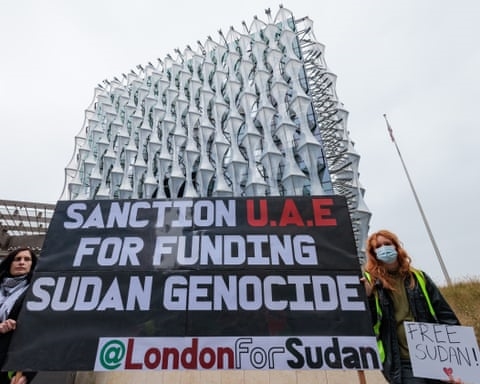
A former government analyst has come forward with allegations that senior UK officials deliberately suppressed warnings of a potential genocide in Sudan. The whistleblower claims the term “genocide” was removed from an internal risk assessment to avoid implicating a strategic partner in the Gulf.
According to the source, who worked on early-warning reports for the Foreign, Commonwealth and Development Office (FCDO), a humanitarian assessment compiled in the early days of Sudan’s civil war in April 2023 was altered. The original analysis reportedly warned of a clear risk of genocidal violence in the Darfur region, but this language was allegedly deleted before the report was disseminated.
The analyst believes the censorship was politically motivated, aimed at protecting the United Arab Emirates (UAE). The Gulf nation, a major UK ally, has been repeatedly accused of supplying arms to the paramilitary Rapid Support Forces (RSF), the group now accused of carrying out atrocities in Darfur. The UAE has consistently denied these allegations.
“The word genocide was removed from our report,” the analyst stated. “Anyone who has studied the patterns in Sudan knew this was a risk. It felt like censorship.”
This account is supported by a former FCDO official familiar with the department’s atrocity prevention work. They drew parallels to previous instances, such as concerns over the conflict in the Democratic Republic of the Congo, where they claim human rights assessments were similarly sidelined for political reasons to maintain relations with involved states like Rwanda.
The FCDO has rejected the characterization that politics influences its genocide determinations. A spokesperson stated, “The UK does not make formal determinations of genocide on the basis of politics. It does so based on the judgment of a competent court… and there is currently no such judgment in the context of Sudan.”
However, the timeline of events appears to underscore the warnings. Shortly after the April 2023 report was finalized, ethnic violence surged in Darfur. By June of that year, a massacre in El Geneina claimed an estimated 15,000 lives from non-Arab communities. Most recently, the RSF’s capture of El Fasher last month has been followed by reports of systematic killings and mass graves, with tens of thousands of residents missing.
Critics argue that the UK’s reluctance to use the term “genocide” operationally, despite mounting evidence, has had dire consequences. “Our concern is that Foreign Office officials appear to have deliberately downplayed the risk of genocide precisely as Sudan was descending into one of the worst episodes of mass atrocities in recent memory,” said Abdallah Abu Garda of the Darfur Diaspora Association.
Experts had warned for years that the UK’s systems were ill-equipped to prioritize atrocity prevention. Testimony to a parliamentary committee in June 2023 indicated that even when alarms were raised within the FCDO, there was no effective mechanism to escalate them urgently to ministerial level.
“The RSF’s assault will continue,” said one foreign policy expert on mass violence. “Our government’s expertise and systems must be fit for the urgent purpose of averting further catastrophe.”
The whistleblower’s testimony raises profound questions about whether the UK’s diplomatic relationships are compromising its duty to sound the alarm on crimes against humanity, even as it holds a leading role on Sudan at the United Nations Security Council.