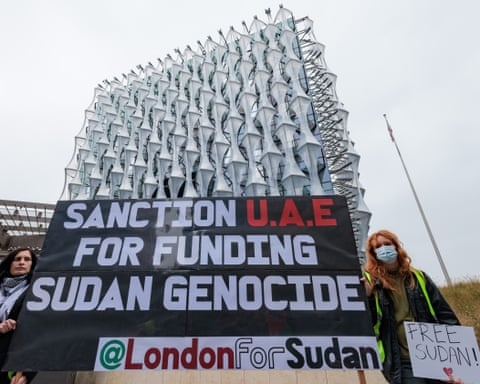
A former government analyst has come forward with allegations that the UK Foreign, Commonwealth and Development Office (FCDO) deliberately censored early warnings of a potential genocide in Sudan. The whistleblower claims officials removed the term “genocide” from a critical risk assessment compiled shortly after the outbreak of civil war in April 2023.
The analyst, who has requested anonymity, asserts that the suppression of this language was politically motivated, aimed at shielding the United Arab Emirates (UAE)—a major British ally—from international scrutiny. The UAE has been repeatedly accused of supplying arms to the paramilitary Rapid Support Forces (RSF), the group now at the centre of widespread atrocities in Sudan’s Darfur region.
“Anyone with knowledge of Sudan’s history knew genocide was a clear and present danger. Yet the word was stripped from our reports,” the analyst stated, describing the act as a form of censorship. This is particularly significant given the UK’s role as the United Nations Security Council’s lead nation, or “penholder,” on Sudan.
These claims are supported by a former FCDO official familiar with the department’s atrocity prevention work. They drew parallels with previous instances, such as concerns over the conflict in the Democratic Republic of the Congo, where similar warnings were allegedly sidelined to avoid complicating UK relations with Rwanda.
“The pattern appears identical,” the former official said. “Assessments are dropped for political reasons.”
The FCDO has rejected these allegations, stating that formal determinations of genocide are not political decisions but legal judgments best left to competent courts. A spokesperson emphasised that no such court has yet ruled on the situation in Sudan.
However, the timeline of events appears to underscore the warnings. Just months after the allegedly altered report was finalised, the RSF launched a brutal assault on the city of El Geneina in West Darfur. United Nations estimates suggest around 15,000 people from non-Arab communities were killed—an episode many experts label a genocide.
The crisis has since escalated. Last month, the RSF captured El Fasher, another major city in Darfur, unleashing systematic mass killings and prompting reports of mass graves. Tens of thousands of residents remain unaccounted for.
Critics argue that the UK’s reluctance to robustly identify the risk has had dire consequences. Abdallah Abu Garda, chair of the Darfur Diaspora Association, stated that downplaying the threat “fostered impunity and contributed directly to further genocidal campaigns.”
Despite the US formally declaring in January that genocide had been committed in Sudan by the RSF, the UK has not followed suit. While the British government says it supports international accountability mechanisms, the whistleblower insists that early-warning systems within the FCDO were compromised from the start.
“The purpose of these reports is to outline worst-case scenarios to trigger action,” the former analyst said. “When you remove the most accurate and alarming term, you undermine the entire system. It wasn’t just semantics—it was a failure to sound the alarm.”