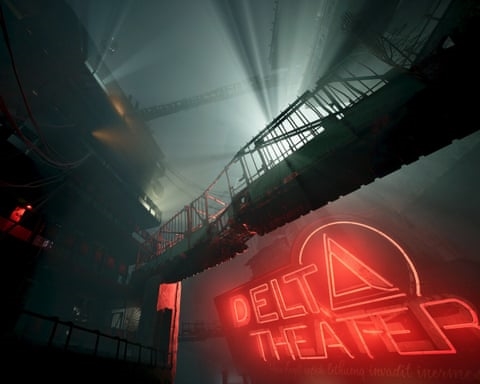
The first-person horror game Sleep Awake presents a world of striking decay and surreal beauty, but ultimately stumbles under the weight of conventional and uninspired gameplay.
The game’s greatest strength lies in its desolate, painterly setting: the ruins of what may be Earth’s final city. Players navigate this landscape as Katja, a young woman traversing crumbling rooftops and shadowy, maze-like streets that evoke a profound sense of loss and architectural grandeur. The atmosphere is thick with melancholy, amplified by a central, compelling dread. In this world, a mysterious affliction known as the Hush means that falling asleep is not rest, but a terrifying disappearance. To stay conscious, citizens rely on eye-drops that induce waking hallucinations, fracturing reality into psychedelic, kaleidoscopic visions and pushing the remnants of society into paranoid, sleep-deprived conflict.
This promising premise, however, is undermined by mechanical execution that feels dated and lacking in tension. Core gameplay revolves around rudimentary stealth, where players hide from enemies who patrol on simplistic, predictable routes with unrealistically broad fields of vision. The challenge evaporates quickly, reducing potential moments of fear to a mundane game of hide-and-seek. Objectives are equally uninspired, often boiling down to finding conspicuously placed keycards or solving basic environmental puzzles, like rolling a cart into a circuit breaker.
The experience begins to feel less like exploring a living nightmare and more like walking through a lavishly decorated but ultimately linear tunnel. The initial awe of the city’s art direction fades as it becomes clear the player’s path is heavily prescribed, offering little real agency or surprise. This is a particular disappointment because the game’s visual artistry is frequently bold. It employs blurred, beautiful full-motion video sequences and layers unsettling, hallucinatory imagery directly over the 3D environment to create a genuinely disorienting, arthouse effect.
A notable, if bizarre, late-game cameo—featuring a famous synthpop artist voicing a gigantic floating head—epitomizes the game’s struggle. It introduces a shot of schlocky energy, but feels disconnected from the earlier tone and, like much of the game’s surreal aesthetic, is presented without meaningful interactive depth.
One of the few mechanics that successfully marries theme and interaction is the death sequence. Instead of a simple reload screen, being defeated transports the player to a dark space where they must walk toward a radiant door, the environment morphing in real-time around them. It’s a brilliant, fleeting moment that captures the eerie logic of dreams and the liminal space between consciousness and sleep.
For the majority of its runtime, however, Sleep Awake wears its dreamlike concepts as a superficial skin rather than weaving them into the fabric of its gameplay. The result is an experience that is too straightforward, too easily understood, and not nearly illogical or terrifying enough where it counts. Its captivating vision is, unfortunately, let down by execution that feels wide awake to convention and fast asleep to innovation.