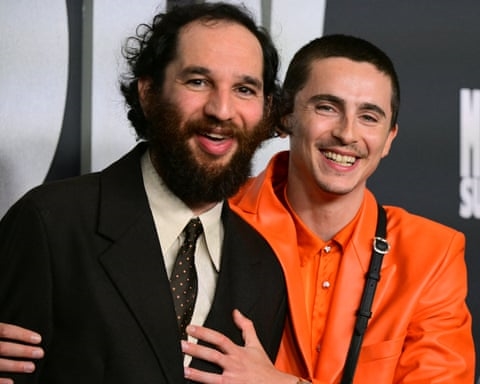
The new feature film Marty Supreme, starring Timothée Chalamet, follows the relentless quest of a 1950s New York table tennis prodigy determined to reach the world stage. The project marks a solo turn for director Josh Safdie, previously known for collaborative works with his brother.
The narrative tracks Marty Reisman, a clerk who hustles to fund his journey to international championships. The film, noted for its vibrant 1980s-inspired score and ensemble cast, is positioned as a major awards contender. Its supporting roles feature an eclectic mix of figures from film, fashion, academia, and music.
In a recent discussion, the filmmaker explored the themes at the story’s core. He described his protagonist as embodying a postwar American confidence—a belief that an individual from anywhere could achieve greatness. That ethos, he suggests, was commercially repackaged in the 1980s, an era whose cultural shadow still looms large. Today, he argues, that dream of prosperity feels more distant, encased in layers of irony and harder to grasp.
The film’s spirit is indebted to classic mid-century literature about determined young men navigating a chaotic city. The director cited specific novels chronicling life on New York’s Lower East Side as key influences, alongside various nonfiction sources.
A question of cultural anxiety is woven through the plot. The director reflected on a certain restlessness within Jewish culture, born from a historical sense of impermanence and constant rebuilding. This underlying tension, he noted, informs his character’s driven nature.
The story introduces a formidable antagonist in Milton, a billionaire portrayed by a well-known television entrepreneur. In a pivotal scene, Milton describes himself as a “vampire.” The filmmaker explained this as a metaphor for a certain kind of corporate colonialism that emerged after the war, depicting Milton as a parasitic force that drains vitality from people and places, yet operates with a destructive artistry.
One of the film’s most poignant moments involves a fellow player recounting a harrowing act of sacrifice in a concentration camp, based on a true historical account. The director contrasted this image of life-giving sustenance with the vampiric imagery elsewhere, noting how the sport historically attracted brilliant, eccentric minds who saw beyond conventional boundaries.
This theme extends to a scene where an older character is seen literally biting the neck of the young protagonist—a visual metaphor for a culture obsessed with draining youth and passion. The director expressed a broader concern about the modern pursuit of extreme longevity and the existential importance of an ending. He also revealed a personal preoccupation with digital impermanence, citing it as a reason he prefers shooting on physical film stock, a more durable medium against potential loss.
The film’s structure is uniquely framed around a nine-month period, opening with the moment of conception. The director connected this to an exploration of modern fatherhood and masculine purpose. He suggested that while women have a concrete, biological role in creation, men can often feel spiritually adrift, compelled to compete and “father” an external dream or legacy, much as the protagonist does.
Ultimately, Marty Supreme presents itself as a kinetic period piece about sport and ambition, while quietly grappling with enduring questions about identity, legacy, and what it means to build something lasting in a transient world.