From legendary heroes to local icons, the crests of football clubs often tell a story far deeper than the sport itself. While many badges feature animals, objects, or abstract symbols, a fascinating subset across the world’s leagues immortalises the human face.
The question of which clubs feature people on their emblems has sparked considerable interest, revealing a diverse gallery of historical and cultural figures sewn onto kits from South America to South Asia.
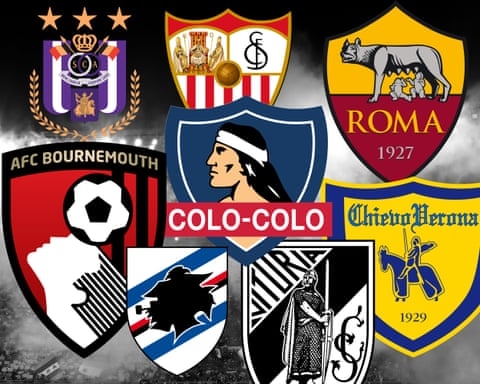
In Chile, the badge of Colo-Colo proudly displays the likeness of the 16th-century Mapuche chieftain who resisted Spanish colonisation, a symbol adopted by the club since its founding in 1925. Across the Atlantic, Portugal’s Vitória de Guimarães features Afonso Henriques, the nation’s first king, while Sevilla’s intricate crest depicts Ferdinand III of Castile alongside saints.
Some tributes are more modern. AFC Bournemouth’s iconic striker silhouette is modelled on 1960s forward Dickie Dowsett, commemorating a famous diving header. In Bangladesh, Sheikh Russell KC honours its namesake, the young son of a former president, in a poignant memorial.
The tradition extends beyond Europe. Ecuador’s Papá Aucas features an indigenous Huaorani profile, a nod to the club’s origins linked to oil exploration in the Amazon. In the United States, the original crest of Columbus Crew showcased three anonymous hard-hatted workers, a tribute to the city’s blue-collar identity.
From Greek war heroes on the badges of PAS Lamia and Asteras Tripolis to the sailor profile of Genoa’s Sampdoria, these emblems serve as permanent, wearable history. They transform a club’s identity into a canvas for storytelling, where every match is played beneath the gaze of a king, a revolutionary, a local saint, or a footballing legend.