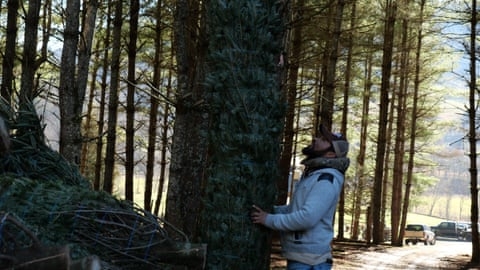
As the holiday season winds down, the final trucks are being loaded at tree farms across the Appalachian highlands. The crews completing this work are predominantly men who have traveled from Mexico under temporary agricultural visas. For them, the end of the harvest means a long-awaited reunion with their families. However, new federal wage policies and a tense political climate are casting doubt on whether this annual migration will continue, threatening the foundation of a multi-million dollar industry.
The cultivation of Christmas trees, particularly the prized Fraser fir, is a year-round endeavor requiring meticulous care—weeding, pruning, fertilizing, and shearing. It takes nearly a decade to grow a mature tree. This labor-intensive process has long relied on a workforce arriving each spring through the H-2A visa program. Industry representatives acknowledge that domestic workers are rarely willing or able to sustain the demanding, seasonal work.
“We do this for the economic opportunity,” explained one veteran worker with over two decades of experience, who spoke on condition of anonymity. “If that opportunity shrinks, it forces a very difficult calculation.” The calculation he references is a response to newly implemented wage guidelines that could significantly reduce hourly pay for visa holders. While aimed at cutting costs for employers, the move risks deterring the very workers the industry depends on.
The work is physically grueling, often involving 12-hour days during the peak harvest, and can lead to chronic musculoskeletal issues and exposure to chemicals. Beyond the physical toll, workers describe profound isolation, living in employer-provided housing far from town centers and separated from their families for most of the year. Their legal status, while documented, creates vulnerability, as their housing and transportation are typically tied to their employer.
“There is a constant feeling of precariousness,” said an advocate for farmworker rights in North Carolina. “Between the political rhetoric, the potential for racial profiling, and now the threat of lower wages, many are questioning if the sacrifice is still worth it.” This anxiety persists despite a lack of recent immigration enforcement actions in the rural farming regions.
The economic stakes are substantial. Christmas trees are a top agricultural commodity in western North Carolina, contributing over a hundred million dollars to the state’s economy annually. Farms ship trees nationwide. A sharp reduction in the available workforce would not only disrupt a holiday tradition but also deliver a severe blow to a regional economy still recovering from recent natural disasters.
Growers are caught in a bind. One farm owner expressed deep reluctance to cut wages for a loyal and skilled crew but worries about being undercut by competitors who do. “These men work incredibly hard. Their expertise is what makes this possible,” she stated. That expertise is a non-renewable resource; replacing an experienced team with new, untrained workers each season is neither practical nor efficient.
For the workers, the debate transcends economics. It touches on dignity and value. “We are an economic pillar, both here and for our communities at home,” one worker noted. “When our wages are cut, it sends a message that our contribution is not respected. It feels like a humiliation.”
As the last trees of the season are shipped, the question hanging over the misty fields is not about the next harvest, but who will be there to tend it. The future of the real Christmas tree for American households may well depend on the answer.