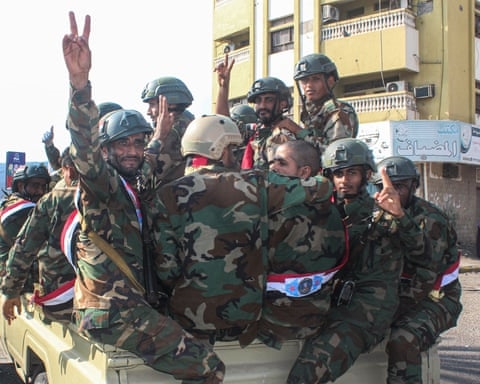
Forces aligned with the Southern Transitional Council (STC) have consolidated their military control over the entirety of southern Yemen, marking a decisive shift in the country’s decade-long conflict and setting the stage for a potential bid for independence.
In a series of coordinated moves, thousands of STC troops advanced into the Hadramaut and Marah governorates last week, the final two regions in the south previously outside their direct authority. This military success grants the UAE-backed separatist group command over all eight governorates that once constituted the independent state of South Yemen.
The development represents a significant geopolitical setback for Saudi Arabia, which had been the predominant external power in Yemen’s civil war. In a clear sign of the shifting balance, Saudi forces have withdrawn from key positions in the southern capital of Aden, including the presidential palace and airport. This retreat underscores the diminished influence of the Riyadh-backed factions within Yemen’s internationally recognized government.
Analysts suggest an immediate, unilateral declaration of independence by the STC remains unlikely, given the precarious diplomatic precedent set by other contested statehood claims. Instead, the group is expected to pursue a more gradual strategy, potentially involving a future referendum on separation from the north. The ultimate decision will heavily depend on the strategic calculus of its primary patron, the United Arab Emirates.
The power shift ends an unstable political arrangement that had governed the south since 2015, a coalition between the Saudi-supported Islah party and the STC. With superior military strength, STC leader Aidarous al-Zubaidi has now seized control of critical assets, including Yemen’s largest oil company, PetroMasila, significantly bolstering his bargaining position.
The consolidation of the south fractures the previous international roadmap for Yemen, which focused on a unified federal solution involving the Houthi movement that controls the north. Western diplomats have reportedly engaged with Zubaidi to assess his intentions, particularly regarding relations with external powers like Russia and the ongoing campaign against the Iranian-backed Houthis. No Western government has yet issued a public statement on the new reality.
This realignment is seen as the most consequential shift in Yemen since the Houthi capture of Sana’a in 2015, with the potential to redraw regional alliances and even strain relations between the UAE and Saudi Arabia. For Riyadh, a major concern will be the security of its long border with Yemen, given past cross-border attacks by Houthi forces.
Regional observers note that the UAE’s green light for the STC’s offensive may be linked to broader Gulf rivalries, possibly in response to Saudi diplomatic maneuvers concerning the conflict in Sudan. As the situation solidifies, a Saudi delegation remains in Hadramaut under pressure to salvage some influence from the dramatically altered landscape.