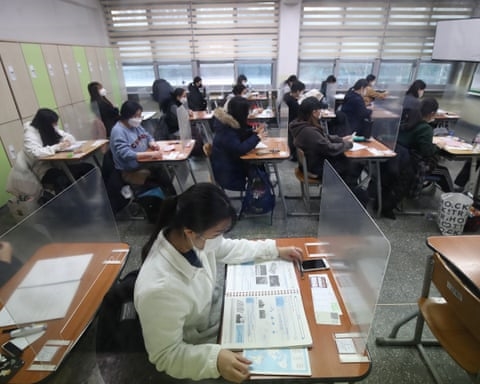
The director of the agency responsible for South Korea’s national university entrance examination has resigned in the wake of widespread criticism that this year’s English language section was excessively challenging.
The exam, a pivotal event in the country’s academic calendar, is seen as a critical determinant of future career prospects and social standing. However, the recent test sparked significant public outcry after only a small fraction of candidates achieved the highest score in English, marking the lowest top-score rate in several years.
The contentious questions required students to engage with complex philosophical concepts within a tightly constrained timeframe. Tasks included comparing the legal theories of historical thinkers and examining abstract ideas related to time and digital identity. The difficulty level was deemed by many to stray from the assessment’s stated objectives.
The intensity surrounding the exam is such that national measures, including the temporary grounding of aircraft, are routinely implemented to ensure silence during the listening component. The strong reaction to this year’s paper led to the director’s departure, with the official expressing regret for the anxiety caused to students and families and acknowledging a failure to adhere to grading standards.
Further criticism was aimed at the inclusion of obscure terminology, such as an academic neologism not in common usage, which even its originator stated was inappropriate for the test.
This incident has reignited discussions about the immense pressure within the South Korean education system, often linked to concerns regarding student well-being. In a related development, legislators recently moved to curb early academic pressure by prohibiting certain entrance tests for very young children.
The sensitivity of exam results was further highlighted by recent media attention on a high-profile applicant from a prominent business family, underscoring the national fixation on this single set of scores.