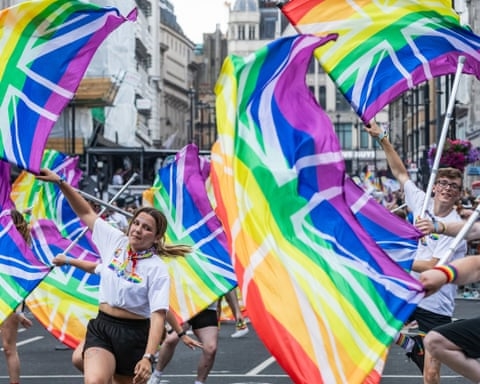
A significant retreat in public corporate backing for Pride celebrations has been observed across major UK and US firms, according to a new analysis. The data indicates a steep decline in social media engagement with LGBTQ+ themes by leading businesses over the past two years, coinciding with a period of increased political and social hostility toward LGBTQ+ rights globally.
The study examined the primary public-facing social media accounts of the ten largest UK-based companies and the ten largest US companies by market value. It found that in 2023, these UK firms collectively made 52 posts referencing Pride events or LGBTQ+ networks. By 2024, that figure had nearly halved to 27 posts. In 2025, only four such posts were identified—a drop of 92% from the 2023 total.
A parallel trend was seen among the top American corporations. Their collective Pride-related social media posts fell from 39 in 2023 to 21 in 2024, and to 18 in 2025. Only one US technology giant showed an increase in posts during this period, while several others, including a prominent electric vehicle manufacturer and a major investment firm, posted nothing on the subject.
Industry observers link this pullback to a changing political environment. The trend follows recent executive actions in the United States that dismantled federal diversity, equity, and inclusion (DEI) initiatives, which appears to have created a chilling effect on corporate advocacy. Experts suggest many companies are now opting to support LGBTQ+ inclusion initiatives more quietly, avoiding high-profile public statements.
“When the environment becomes more hostile, clear signals of support are crucial,” stated the head of a leading LGBTQ+ rights organization. He emphasized that while substantive, year-round inclusion work matters more than seasonal branding, visible symbols like rainbow flags during Pride month send an important message of welcome and safety to LGBTQ+ employees and customers.
However, the decline in public messaging coincides with reports from within corporate circles. Some diversity and inclusion budgets have faced significant cuts, with LGBTQ+ employee networks often being the most affected due to their previous prominence and funding. Some executives argue that the DEI field needed a “reset,” moving away from perceived politicization to refocus on core principles of workplace equality.
The visibility of aggressive online backlash, particularly on one major social media platform now known for amplifying extreme viewpoints, is also cited as a deterrent for companies considering vocal public support. “There’s a fear about endorsing these things now,” commented a former senior social media executive and workplace culture analyst. He noted that for marginalized communities, this corporate hesitation reinforces the idea that principles are often abandoned when they become costly.
Despite the decline in public fanfare, several companies maintain that their commitment is unchanged. Banks and pharmaceutical firms highlighted ongoing support through employee networks, mentoring schemes, sponsorship of local Pride events, and internal policies. They argued that social media metrics do not fully capture their broader efforts to foster inclusive cultures.
The analysis underscores a pivotal moment for corporate social advocacy. As political winds shift, the business world’s once-ubiquitous rainbow branding during June is fading from public view, raising questions about the depth and resilience of corporate commitments to LGBTQ+ equality in an increasingly polarized climate.