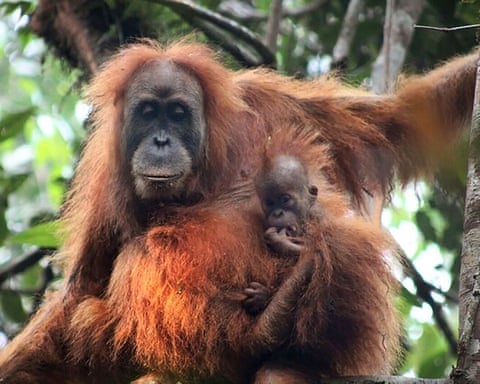
A catastrophic flood event in Indonesia last month has dealt a potentially fatal blow to the survival of the Tapanuli orangutan, the planet’s most endangered great ape species. Conservation scientists now warn the disaster may have wiped out a significant portion of the already critically small population.
The Tapanuli orangutan, identified as a distinct species only in 2017, numbers fewer than 800 individuals in the wild. Their entire range is confined to a fragment of forest in Sumatra. The recent floods, which claimed nearly a thousand human lives, also carved massive scars through the mountainous Batang Toru region, the ape’s last refuge.
Analysis of satellite data reveals the scale of the ecological devastation. Landslides, some stretching over a kilometer long and nearly a hundred meters wide, scoured the landscape. Experts state that the torrent of mud, water, and debris would have obliterated everything in its path.
“This was an extinction-level event for this species,” said one conservation scientist involved in the assessment. “For a population this tiny and isolated, losing even a handful of breeding adults is catastrophic. Our models suggest between 6% and 11% of the population in the hardest-hit sector may have perished.”
The impact extends beyond immediate mortality. The floods destroyed vast tracts of forest, stripping away vital food sources and nesting sites for the surviving apes. This habitat loss leaves the remaining population even more vulnerable and fragmented.
Environmental groups have long raised alarms about industrial projects in the Batang Toru ecosystem, including a hydroelectric dam and a gold mine. Scientists argue that deforestation from such development likely exacerbated the flooding’s severity by destabilizing the terrain. In the disaster’s wake, authorities have suspended permits for regional projects pending a full review.
Conservationists are issuing an urgent call to action. They demand an immediate halt to all habitat-damaging development in the area, a comprehensive survey to assess the exact toll on the orangutans, and the expansion of protected forest areas. The goal is to secure and restore the lowland forests that constitute the species’ natural habitat, to which they have been pushed by encroachment elsewhere.
“The forest has fallen silent,” reported a local conservationist from the region. “To give the Tapanuli orangutan any fighting chance, we must fully protect what little habitat remains. There is no time to lose.”