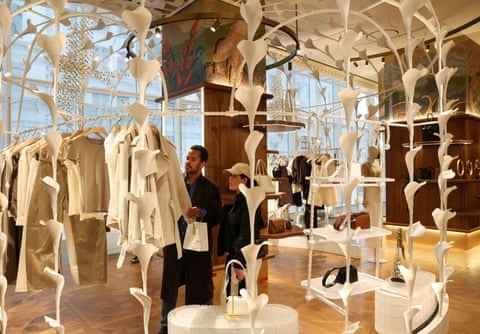
As the holiday season unfolds, the streets of major cities present a starkly contrasting picture. In one world, shoppers browse luxury boutiques where a $600 coat is considered a sensible purchase and a champagne cart roves the aisles. Just steps away, long lines form for free food and essential supplies. This visible chasm underscores a deepening economic split, where a surging stock market fuels lavish spending for a fortunate few while a growing number of Americans grapple with rising costs and diminished support.
The engine of this luxury spending is a financial market that continues to reach unprecedented heights. Major indices have seen extraordinary gains in recent years, significantly boosted by the artificial intelligence sector. However, the benefits are overwhelmingly concentrated. Federal data reveals that the wealthiest 10% of Americans control over 87% of the stock market, while the bottom half of the population holds just over 1%. For this small, affluent segment, high-end retail is not a fantasy but a regular part of life.
For the broader population, the economic landscape feels markedly different. Although the intense inflation spike following the pandemic had subsided, prices have begun climbing again in recent months. Concurrently, key support programs addressing food and housing have seen reductions. Analysts link these policy shifts to an increase in the number of people falling below the poverty line, with rates in some major metropolitan areas reportedly far exceeding the national average.
This divergence has created what economists term a “K-shaped” recovery, a phenomenon where wealth and asset values inflate at the top while many at the bottom contend with the pressures of price inflation on essentials. The gap is not new but has been exacerbated in recent years, creating two distinct consumer realities.
Corporate earnings calls have repeatedly highlighted this divide. Executives from major airlines and beverage companies report robust growth driven by their premium product lines and wealthiest customers. Conversely, leaders in the fast-food industry note that their core, lower-income customer base is under significant strain, often opting to skip meals or eat at home to manage budgets.
The result is a bifurcated holiday season. For those on the upper arm of the “K,” it is a time of comfortable splurging. For a much larger group, it is a period of heightened financial pressure and pulled-back spending. As one luxury shopper succinctly put it, reflecting on his own thriving business, “Rich people are still rich.” The statement captures an economic moment defined not by universal struggle or prosperity, but by a profound and growing separation between the two.