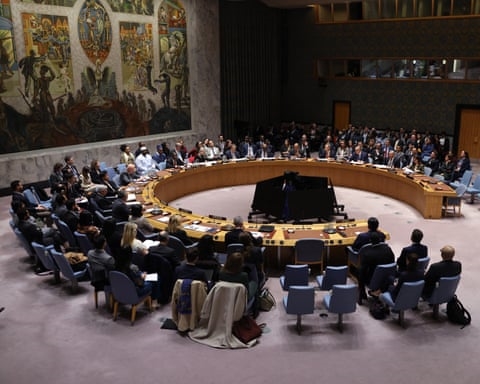
The United Nations Security Council has approved a resolution authorizing the deployment of an international stabilization force to the Gaza Strip. The measure, which passed with broad support, also references a future pathway to Palestinian statehood, a point of immediate contention with the Israeli government.
The US-drafted resolution received 13 votes in favor. Russia and China chose to abstain, but did not exercise their veto power. The text endorses a broader peace framework that includes the creation of an International Stabilisation Force (ISF). This force is mandated to work alongside Israeli and Egyptian authorities, as well as newly trained Palestinian police units, to secure border areas and oversee the demilitarization of the devastated coastal enclave.
A key component of the plan is the establishment of a transitional governing body for Gaza, referred to as a “board of peace,” which is to operate until the end of 2027. The resolution further outlines that, following necessary reforms to the Palestinian Authority and the advancement of reconstruction in Gaza, conditions could be established for a credible process toward Palestinian self-determination and statehood.
However, the prospect of statehood faces firm opposition from Israel. Prime Minister Benjamin Netanyahu reiterated his government’s rejection of a sovereign Palestinian state just prior to the vote, stating its position had “not changed one bit.” This stance casts significant doubt on the implementation of this aspect of the UN-mandated plan.
The militant group Hamas, which is explicitly excluded from any future governance role under the resolution, has rejected the measure. In a statement, the group argued the proposal imposes an “international guardianship” on Gaza, favors Israeli interests, and fails to meet Palestinian political and humanitarian demands. Hamas insists any international force must operate solely under UN supervision at border crossings.
Diplomatic sources indicate that the inclusion of language related to Palestinian statehood was crucial to securing support from Arab and Muslim-majority nations, who are expected to contribute personnel to the stabilization force.
Following the vote, the US envoy to the UN stated the resolution “represents another significant step that will enable Gaza to prosper and an environment that will allow Israel to live in security.” The resolution’s passage marks a significant diplomatic step in international efforts to address the ongoing crisis in Gaza and chart a post-conflict future.