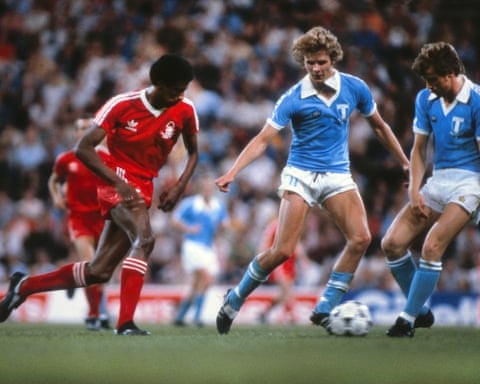
In the opening moments of the 1979 European Cup final, a defensive miscue presented Malmö with a golden opportunity. As the ball fell to striker Jan-Olov Kindvall, he attempted a delicate chip over the advancing Nottingham Forest goalkeeper, Peter Shilton. The effort, however, lacked the necessary lift, and Shilton gathered it comfortably. That fleeting chance would prove symbolic. Malmö’s dream of a monumental upset faded as the match progressed, with the English champions ultimately lifting the trophy.
Reflecting on the match, Kindvall acknowledges the quality of the opposition. “Perhaps if we had scored first, the story could have been different,” he muses. “We were exceptionally well-organized, especially without the ball. Ironically, facing a team that mirrored our own disciplined, direct style made it particularly challenging.” That stylistic similarity was no accident. It was the legacy of their manager, Bob Houghton, an Englishman who had quietly revolutionized Swedish football.
Houghton’s appointment in 1974 raised eyebrows. At just 26, he was younger than some of his players, and his tactical ideas were foreign to a Swedish game then dominated by German-inspired systems featuring a libero. Yet, with the club seeking a new direction under chairman Eric Persson, Houghton found a receptive audience. His philosophy, influenced by advanced English coaching principles, emphasized a flat back four, zonal marking, and repetitive, situation-based training.
The shift was a culture shock. Defender Claes Malmberg recalls the immediate intensity. “We were used to starting pre-season with endless running in parks,” he says. “Bob took us straight to the pitch with a ball. At first, we worried about fitness, but his methods were convincing.” Houghton’s success was sealed by winning over the squad’s leader, the revered Bo Larsson. His endorsement was crucial: if Larsson believed, the team would follow.
The results were swift. League titles in 1974 and 1975 validated Houghton’s approach. He even facilitated the hiring of his friend and former assistant, Roy Hodgson, at rivals Halmstad, who promptly won the 1976 championship. By the time Malmö qualified for the 1978-79 European Cup, Houghton’s system was a machine built on collective understanding and defensive repetition.
“The individual technical level today is higher,” Kindvall notes, “but our organization and defensive cohesion were exceptional. We drilled it constantly. Every session had a defensive component. It was about the unit; if one link failed, the chain broke.”
This disciplined unit navigated a remarkable European path. They edged past Monaco, with Kindvall scoring a decisive away goal. A trip to the Soviet Union to face Dynamo Kyiv yielded a stalemate in Kharkiv before a comfortable victory at home. A stunning four-goal burst saw off Wisla Krakow, and a tight semi-final victory over Austria Wien booked their place in the final against the mighty Nottingham Forest.
Fate, however, intervened cruelly before the showdown in Munich. Key players Bo Larsson and Roy Andersson were injured, and captain Staffan Tapper was hurt in the final training session. He attempted to play but lasted only 20 minutes. Malmberg replaced him, stepping into a well-drilled system. “We knew every position, every movement,” he says. “There was no panic.”
Yet, the absences took their toll. “We were a better team in April than in May,” Kindvall concedes. The gulf in resources was underscored by Forest’s match-winner: England’s first million-pound footballer, Trevor Francis.
While the memory of his early chance lingers, Kindvall’s overwhelming emotion is one of pride in the achievement itself. A squad largely comprised of local semi-professionals—a teacher, an engineer, a salesman—had come within touching distance of continental supremacy. “The entire journey was fantastic,” he concludes. “It would be absolutely impossible to replicate today.”