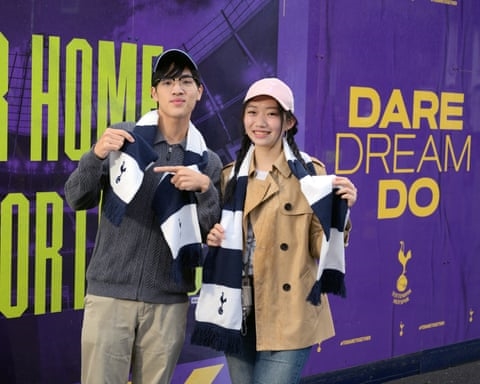
The scene outside the stadium was one of eager anticipation, filled with supporters adorned in club colors. Among them, a young couple stood out, not for their enthusiasm—which matched everyone else’s—but for an ugly moment that briefly pierced the matchday atmosphere. A passing shout of abuse, aggressive and unprovoked, was directed squarely at them. They shrugged it off, but the incident hung in the air, posing a silent, uncomfortable question about belonging and identity in the stands.
For these fans, and for countless others across Asia, their journey to this London ground began not with a local family tradition, but with the career of one man: Son Heung-min. Over a celebrated decade, the South Korean forward did more than score goals; he built a bridge. His ascension to the club captaincy in 2023, a historic first for an Asian player in the Premier League, wasn’t just a personal milestone. It was a powerful signal, perceived globally, about the club’s identity.
That signal resonated deeply with supporters like Sun, a university student from Singapore now living in London. For him, choosing a club to support was part of integrating into a new culture. The presence of Son, especially as a leader, made the choice clear. “As an Asian person coming to the UK, you’re aware you’re a minority,” Sun explains. “Seeing that leadership made me feel this club understands diversity and wants to embrace it. It made me feel safer being part of this crowd.”
Son’s appeal transcended his athletic prowess. Fans frequently cite his demeanor—respectful, humble, and gracious—as embodying values they recognize and admire. His iconic bow to supporters after a major victory wasn’t just a celebration; it was a cultural gesture that resonated across continents. For brothers Mike and Paul Chung, visiting from New York, Son is a “cultural touchstone.” “He validates that a Korean can be among the best in the world’s most popular sport,” Mike states, wearing Son’s old jersey with pride.
The economic and social impact of this connection is tangible. Stadium vendors report scarves bearing Son’s name still sell out after big matches. Fans travel from across the globe, some without tickets, simply to be near the ground their hero called home. Junoh Yoon, a student from South Korea studying in Ireland, made such a pilgrimage. “I’m a fan because of Son,” he admits, “but I’m a fan of the whole team now. I’ve followed them for eight years.”
Yet, this wave of international support sometimes meets a undercurrent of resentment. In online forums, some question the legitimacy of newer, overseas fans, accusing them of being mere “tourists” who displace local supporters. Austen Chan, who moved to London from Hong Kong, has witnessed this digital gatekeeping. “I’ve seen accusations that Korean fans are only here for Son, taking spots from ‘legitimate’ fans,” he says. He argues that fandom shouldn’t be measured by geography. “Staying up until early hours to watch games from the other side of the world shows just as much commitment.”
Despite occasional hostility, positive encounters are more defining. Sun recalls an early train journey to a match, where a group of older, lifelong supporters spotted him and his girlfriend. “They asked if it was our first game, shared stories about the club’s history, and told us how long they’d been supporters,” he remembers. “It felt like a welcome, an invitation into a big part of their lives.”
While the player himself has moved on, the community he inspired remains. These supporters, initially drawn by a singular star, have forged their own, lasting bonds with the club. Their support, tested by distance, cost, and sometimes prejudice, has evolved into something permanent. They are no longer just Son Heung-min’s fans; they are, unequivocally, the club’s fans for life, a testament to how a player’s legacy can reshape a club’s community in enduring ways.