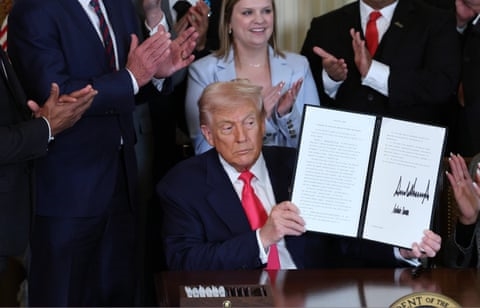
The White House has replaced a series of recently issued pardons after online observers noted that the documents bore seemingly identical copies of the president’s signature. Officials attributed the duplication to a technical error and staffing issues, insisting the chief executive personally signed each order.
The documents in question granted clemency to seven individuals earlier this month, including a former professional athlete, a former state legislative leader, and a former law enforcement officer. After the similarity was highlighted online, the Department of Justice updated its website with new versions featuring more varied signatures.
A department spokesperson stated that an initial, hand-signed pardon was mistakenly uploaded multiple times due to complications stemming from a recent government funding lapse. The spokesperson emphasized that the president signed all seven pardons personally and that the corrected online postings now reflect seven unique signatures.
A White House representative echoed this, affirming the president signs all pardons by hand and criticizing media focus on the incident. The statement contrasted the process with that of the previous administration, which frequently utilized an autopen machine for such documents.
This episode occurs amid a broader political debate over the legitimacy of autopen signatures on official actions. The current administration has previously questioned orders bearing such signatures from the prior president, even symbolically replacing a portrait in the West Wing with an image of the signing device.
One of the recent pardons was granted to a former cryptocurrency executive who pleaded guilty to financial crimes last year. The president later remarked he was unfamiliar with the individual but believed the case represented an unfair prosecution.
Handwriting experts note that genuine signatures naturally exhibit small variations, and perfect duplication is highly unusual. However, legal scholars clarify that the method of signing—whether by hand or machine—does not affect a pardon’s validity if the president’s intent to grant it is clear.
Some congressional Democrats have pointed to the signature issue, echoing arguments previously used by Republicans, to question oversight and procedure within the executive branch. Meanwhile, Republicans on a key House committee have drawn a distinction between the recent incident and the previous administration’s use of the autopen, framing the latter as a potential abuse of authority.
The individuals pardoned include a former state politician recently imprisoned on corruption charges, a former athlete convicted decades ago on tax and drug offenses, and a former police sergeant sentenced for involvement in an international repression scheme.