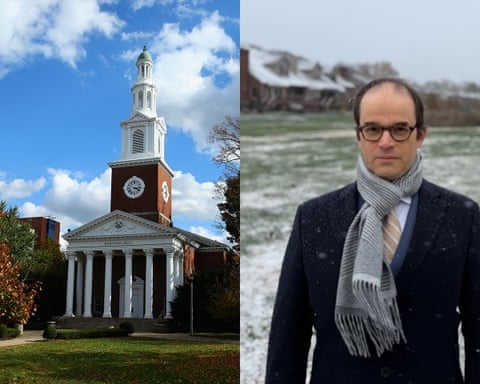
A tenured law professor has filed a federal lawsuit against the University of Kentucky, alleging the institution violated his constitutional rights by removing him from the classroom and barring him from the law school building over his public statements regarding Israel.
The professor, Ramsi Woodcock, argues the university’s actions infringe upon his First Amendment free speech protections and due process rights. The dispute centers on comments in which he characterized Israel as a “colonization project” and endorsed international military intervention against it.
University officials stated the professor was not suspended but “reassigned” pending an internal investigation. The probe was initiated following complaints about his statements, made at academic conferences, on a personal website, and in professional forums. The university alleges his speech violated policies against discrimination and creating a hostile environment, citing a definition of antisemitism that includes certain criticisms of Israel.
In his lawsuit, Woodcock contends that anti-discrimination law cannot constitutionally prohibit criticism of a state. He asserts that equating such criticism with antisemitism unlawfully stifles academic debate on topics like self-determination and colonialism.
The case enters a contentious national debate over the boundaries of academic speech and how universities address polarizing political issues. While the professor’s views are described as beyond mainstream criticism, even some who disagree with him have raised concerns about the implications of his suspension for open discourse.
A retired colleague from the university, while strongly opposing the professor’s views on Israel, publicly defended his right to express them, stating a professor is “entitled to be wrong.” The lawsuit seeks to reinstate the professor and challenges the procedures used to remove him, claiming the university altered its own policies mid-investigation.
The outcome is anticipated to test the limits of free speech protections for faculty at public universities, particularly regarding foreign policy debates.