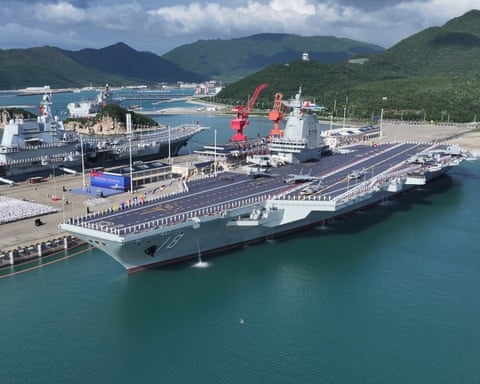
The commissioning of a new, massive aircraft carrier underscores a nation’s commitment to projecting military strength far beyond its shores. The vessel, a significant financial investment, significantly expands its navy’s operational reach, placing it among the world’s top naval powers, though still trailing the fleet of the global leader.
This development highlights a continued belief among major states in the strategic value of these floating airbases. They are seen not merely as weapons of war but as potent instruments of diplomacy and influence, capable of demonstrating resolve and altering geopolitical calculations simply by their presence in a region. Recent history shows such vessels being deployed on demonstrative missions to signal power to other governments.
The investment reflects a long-term ambition to build a navy capable of independent global operations. Analysts point out that while the same nation has developed formidable defenses to protect its coastline from rival forces, it views carriers as uniquely flexible assets. They are considered vital for a range of potential scenarios, from showing the flag to supporting high-intensity operations, including hypothetical future contingencies involving territorial claims.
However, the evolving nature of naval warfare presents new challenges. Conflicts in other regions have demonstrated that smaller, technologically advanced forces can achieve significant effects against traditional naval power using asymmetric tactics, such as coordinated attacks by unmanned surface vessels. These successes, while achieved against a less capable adversary, have sparked global debate about the vulnerabilities of large, high-value warships.
The defense of a carrier hinges on its accompanying strike group, particularly escort ships specialized in air and missile defense. The carriers themselves are engineered to withstand significant battle damage. Historical tests and military doctrine suggest sinking one would require a sustained and overwhelming assault.
For other naval powers with more limited global ambitions, the strategic rationale for operating carriers differs. Their deployments often focus on diplomatic engagement and alliance reassurance rather than direct intimidation or preparing for peer conflict. Their utility is measured as much in political terms as in purely military ones.
The contrasting fortunes in different theaters illustrate a complex picture. In one region, innovative tactics have countered naval might. Elsewhere, the inability to maintain such a symbol of power points to broader industrial and economic challenges. Meanwhile, the launch of a new carrier signals a long-term commitment to a form of military power that remains, for now, a defining symbol of global stature and ambition.