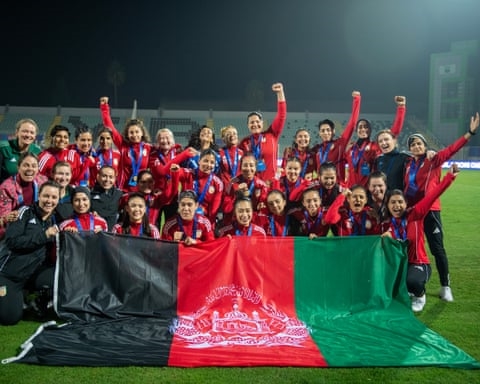
A new women’s national football team representing Afghanistan has taken to the pitch, not from its homeland, but from a diaspora scattered across the globe. Composed entirely of players who fled the country after the Taliban’s return to power, the squad represents a powerful statement of resilience and a lifeline for athletes who lost their right to play.
For team captain Fatima Haidari, football is more than a game; it is a vital form of therapy and a source of collective strength. “On the field, everything else disappears,” she explains. “A fire is lit inside me. I feel I am playing for all the girls who cannot, as if I am holding their hands. That feeling is powerful.”
The team, named Afghan Women United, was established by FIFA as part of a broader initiative to support Afghan women and girls. Its creation aims to provide a competitive pathway for exiled players while advocating for women’s fundamental right to participate in sport. The squad’s recent debut in an international friendly tournament marked a historic and emotionally charged milestone.
The journey to that first match was fraught with logistical hurdles, including a last-minute change of host country. Yet, for the players and their supporters, simply stepping onto the field was a monumental victory. Khalida Popal, a founder of the original women’s national team, watched from the stands, overwhelmed. “It felt unreal,” she said, describing a flood of memories contrasting the new generation of players with the pioneers who came before them.
The project is deeply focused on providing holistic support to athletes who have endured profound trauma—from persecution in their homeland to the challenges of building new lives as refugees. Officials emphasize that creating a professional and safeguarded environment was paramount. “We wanted the players to feel that world-class level of support,” said a senior FIFA women’s football executive involved.
On the pitch, the team’s results were a mix of heavy defeats and a resounding victory. For the players, the scorelines carried a significance beyond sport. “The win sent a different message,” Haidari noted, reflecting on a 7-0 triumph. “People began to celebrate us, to thank us. It reminded everyone that we deserve this.” She stressed that support messages came from men as well, highlighting the shared suffering within Afghanistan.
The initiative is currently a one-year pilot, but organizers believe it has laid a crucial foundation. Future steps include ensuring ongoing support for the athletes and creating pathways into coaching and refereeing.
Amid the focus on football, the players carry a urgent message to the world. Haidari appeals for the international community not to forget Afghanistan and the systematic eradication of future generations, particularly for girls. But her primary message is directed homeward: “Never lose hope and never give up,” she states. “For as long as this team exists, we will keep fighting for you and your freedom.”