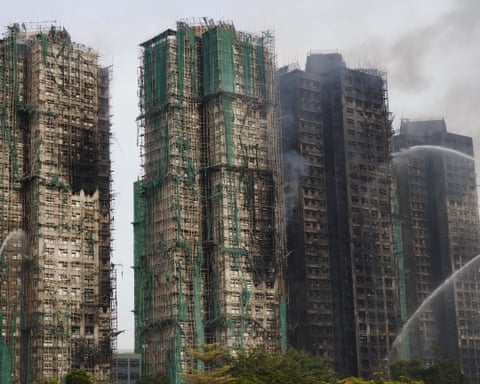
As flames continue to consume a major residential complex in Hong Kong, a profound sense of grief and anger is sweeping through the city. The catastrophic fire at Wang Fuk Court has claimed numerous lives, with the number of fatalities still climbing and hundreds of residents unaccounted for. The disaster, described as the most lethal blaze in Hong Kong in over seven decades, has ignited urgent public debate far beyond the immediate tragedy.
The inferno rapidly spread through multiple high-rise towers in the densely populated estate, home to thousands. While emergency crews battle the fire and search for survivors, public attention is turning sharply toward the causes of the disaster and the official response.
At a recent briefing, city leader John Lee announced a substantial relief fund and pointed to bamboo scaffolding used in ongoing building maintenance as a key factor in the fire’s rapid spread. He stated that authorities would accelerate a shift to metal scaffolding and demanded contractors prove their use of fire-resistant materials within a week.
However, this focus on bamboo has drawn sharp criticism from many residents and observers. They argue it serves as a distraction from deeper systemic failures. Critics note that much of the bamboo framework survived the blaze, while the protective netting burned away. Bamboo scaffolding is also valued locally as a cultural tradition, setting the city apart from construction practices on the mainland. The suggestion that it is the primary culprit is seen by some as an attempt to deflect from investigating potential negligence by construction firms and inadequate safety oversight.
Long-standing complaints from residents about substandard work by the maintenance company have surfaced. A former local councillor for the area noted that warnings had been raised for months. A leaked communication from last year, attributed to a government department, reportedly stated the renovation posed a “relatively low” fire risk as it did not involve open flames, highlighting a possible regulatory gap.
Authorities have since arrested three individuals linked to the maintenance firm, and the anti-corruption agency has opened a criminal probe into the renovation project. Yet, trust in official investigations is low. Legal experts and community figures express doubt that a truly independent public inquiry will be convened, citing a broader erosion of judicial and political checks and balances in recent years. They argue that without effective opposition voices, holding the government to account has become significantly harder.
The central government in Beijing has responded with pledges of support, with major state-affiliated companies promising large aid donations and the military expressing readiness to assist. Meanwhile, Leader John Lee has indicated that upcoming legislative elections may be postponed due to the disaster—a move that echoes a previous postponement which critics say helped sideline political opposition.
The tragedy has laid bare acute anxieties over housing safety in one of the world’s most crowded and expensive cities, where many have little choice but to live in densely packed towers. The search for answers continues amid the smoke, with a community demanding accountability, not just explanations.