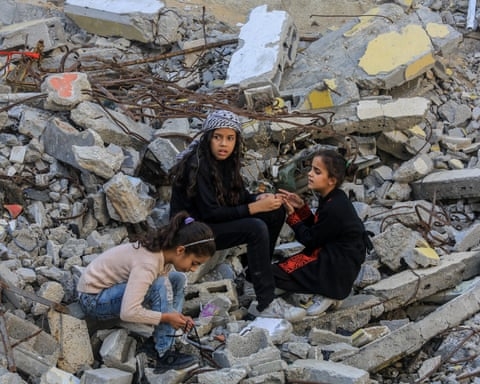
The announcement of a ceasefire in Gaza has failed to halt the suffering of its people. Recent reports indicate continued violence, with dozens of casualties, including children, in the days following the truce. Even when the guns fall silent, the devastation of Palestinian society persists, exacerbated by severe restrictions on aid and the long-term consequences of a prolonged conflict. International health authorities warn that the damage to Gaza’s medical infrastructure will affect generations to come.
Critical shortages of food and shelter define daily life. Displaced families endure winter conditions in flooded, makeshift encampments, with aid agencies unable to distribute basic supplies like tents due to Israeli restrictions on materials deemed to have potential military use. The situation for children is particularly dire, with accounts of them sleeping in sewage-soaked clothing on open ground.
Against this backdrop, a proposed international plan for Gaza’s future has emerged. The strategy reportedly envisions dividing the territory into secured zones for reconstruction and other areas left in ruins, relying on an international stabilization force. Critics argue this model mirrors failed past interventions in other regions and would effectively cement Israeli control under an international guise.
This framework underpins a recent United Nations Security Council resolution that endorses a U.S.-led peace initiative. While the resolution gained some regional support by including references to a future Palestinian state and Israeli withdrawal, these commitments are vague and conditional. They are presented not as inherent rights but as potential rewards contingent on meeting unspecified standards, largely defined by Israel and its allies. Many nations appear to have supported the resolution based on hope for its interpretation rather than its explicit content.
Some view this diplomatic outcome as the best achievable under current political circumstances. Others hold a sliver of hope that it could provide a starting point for more substantive progress. However, a prevailing sentiment is that for many governments, the move serves more to ease international conscience than to genuinely prioritize Palestinian welfare. This is underscored by decisions from key allies, like one European power, to resume arms exports to Israel.
As one analyst starkly observed, the conflict risks transforming from an open war into a permanent state of despair. For the people of Gaza, trapped in ruin and deprivation, the ceasefire has not brought an end to their ordeal but has instead ushered in a new phase of protracted misery. The international community, having been complicit in the war’s brutality, bears a profound responsibility to demand a just and sustainable path forward.