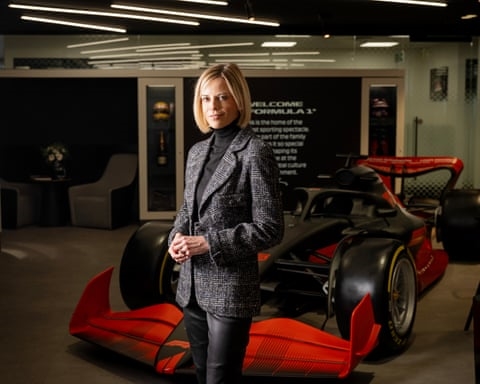
The journey through motorsport’s junior categories has often been a solitary one for women. Susie Wolff, now at the helm of the all-female F1 Academy championship, recalls the profound isolation of her early career, racing against future champions like Lewis Hamilton and Nico Rosberg. Her experience, she notes, was shaped by an environment where being “the girl” was a defining, and often limiting, characteristic.
Wolff describes a paddock culture, prior to broader societal shifts, where the casual objectification of women was commonplace. This atmosphere necessitated a personal code of conduct far stricter than that of her male peers. “I realised I’d have to be whiter than white to get through it unscathed,” she states, highlighting the additional pressures faced.
This isolation, she believes, is what the F1 Academy aims to eradicate. The series provides a crucial support network, ensuring young female drivers have peers to relate to and mentors to guide them—a camaraderie Wolff lacked. She points to the visible change at grassroots levels today, with far more girls in karting, competing not as novelties but as genuine contenders for victory.
Her path required a resilience forged early. Wolff recounts a formative karting incident where a rival, frustrated at being unable to pass her, deliberately drove her off the track. Facing both the boy and his angry father, she stood her ground and saw her competitor disqualified. “I toughened up from a young age,” she says, a trait that proved both a shield and a burden, hardening her against a system that often sought to diminish her achievements.
Even success came with a asterisk. After a strong finish in a world karting championship, she was called to the podium separately as the “best female” driver—a moment that crystallized her different status. “I wasn’t there to be the top female,” she reflects. “I was there to try and be the best.” This perception intensified as she climbed the racing ladder, compounded by sponsor expectations to conform to stereotypically “girly” images, conflicting with her desire to be seen simply as a racer.
The professional hazards extended beyond the track. Wolff details a frightening late-night experience early in her career, where a powerful figure in Formula 1 aggressively banged on her hotel room door. The incident, detailed in her new book, underscores the vulnerability many women faced. “I was lucky he didn’t get in the room,” she says, “but people should realise how frightening it is.” She confided in no one for years, only sharing the story after meeting her future husband, Toto Wolff, who encouraged her to embrace authenticity above all.
Her driving career culminated in a role as a test driver for the Williams F1 team. A near-miss for a race debut in 2015, when she was passed over for a driver with no team affiliation, served as a “real wake-up call.” It was the moment she accepted that a Formula 1 race seat would not materialize. “If you’re not going to give me the chance now, you never will,” she concluded, ending her active driving pursuits.
Now, as Managing Director of F1 Academy, her mission is to create the pipeline she never had. While she regrets once putting a ten-year timeline on producing a female F1 driver—not wanting to pressure the current generation—she remains confident it will happen within that horizon. “I see the talent coming through,” she asserts.
Her work continues against a backdrop of institutional challenges. Wolff is pursuing legal action against the FIA, the sport’s governing body, following what she calls an “absurd” conflict-of-interest investigation targeting her and her husband in late 2023. The case was dropped within days amid unified support from F1 teams, but Wolff is determined to see the matter through. “I wouldn’t have done it if I didn’t think it was worthwhile,” she states.
The ultimate validation of her efforts, however, is seen in the changing attitudes of the next generation. She recalls her young son and his karting rivals discussing a fast female competitor, Greta, purely on the merit of her speed. “They speak about her as just another competitor, a potential winner of the race,” Wolff observes with a smile. “Twenty years ago I was ‘the girl’… The whole mindset has shifted.”
For Wolff, the goal is clear: to normalize female participation at every level until a 50-50 split between boys and girls in karting becomes the foundation for a more inclusive future at the pinnacle of motorsport.